

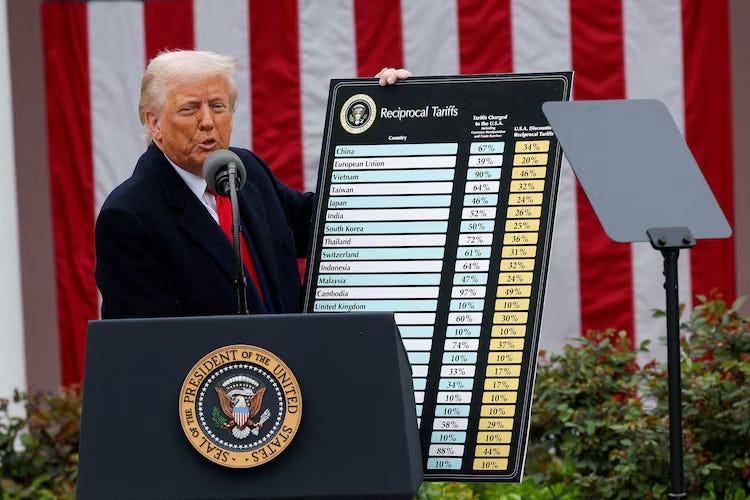
Photo: Carlos Barria/Reuters
Overview
Date: August 29-30, 2025
Summary: A federal appeals court ruled that many of President Trump’s tariffs, imposed under the International Emergency Economic Powers Act (IEEPA), are illegal, asserting that the power to levy such sweeping taxes rests with Congress. The 7-4 decision affirmed a lower court’s finding that the IEEPA does not grant the president “unbounded authority” for broad tariffs. While the ruling casts doubt on a cornerstone of Trump’s trade strategy, the tariffs will remain in effect until mid-October to allow the administration to appeal to the Supreme Court. Trump criticized the decision, vowing to win and emphasizing the importance of tariffs for the country’s financial strength.
Sources
The New York Times - Trump’s Sweeping Tariffs Invalidated by Appeals Court
CNN - Appeals court strikes down many Trump tariffs, but delays enforcement until October
NBC News - Trump’s tariff push overstepped presidential powers, appeals court says
Fox News - Federal court strikes down Trump tariffs as illegal under federal law in appeals ruling
The Washington Post - Ruling on Trump’s tariffs is a major setback for the White House
The Wall Street Journal - Appeals Court Rejects Trump’s Global Tariffs
The Wall Street Journal - Six Months Into Tariffs, Businesses Have No Idea How to Price Anything
Key Points
A federal appeals court ruled that President Trump’s use of the International Emergency Economic Powers Act (IEEPA) to impose many of his sweeping tariffs was illegal.
The court affirmed that the power to impose taxes, including tariffs, is a “core Congressional power” vested exclusively in the legislative branch by the Constitution.
The IEEPA does not explicitly grant the president authority to impose tariffs of the “magnitude” seen in Trump’s actions and does not even mention the word “tariff” or its synonyms.
The 7-4 decision upheld a lower court’s initial ruling from May.
Despite the ruling, the tariffs will remain in effect until mid-October to allow the Trump administration time to appeal the case to the Supreme Court.
President Trump strongly criticized the court’s decision on social media, calling it “Highly Partisan” and stating that the tariffs are essential for the country’s financial strength and that the US will ultimately win.
The White House, through spokesman Kush Desai, defended the president’s actions as lawful and expressed confidence in an “ultimate victory.” Attorney General Pam Bondi also confirmed the administration would appeal.
The ruling specifically affects tariffs imposed under IEEPA, including “reciprocal” tariffs and those targeting alleged fentanyl flows from Canada, China, and Mexico. It does not affect tariffs imposed under other laws, such as Section 232 (e.g., on steel, aluminum, autos).
Dissenting judges argued that IEEPA’s language and history do grant the president some authority to impose tariffs in an emergency context.
Unique Highlights
The New York Times highlights that no president before Trump had invoked the IEEPA to tax imports and notes that during Trump’s first term, his own advisers questioned its use for broad tariffs.
CNN provides details on specific administration officials' warnings to the court: Treasury Secretary Scott Bessent warned of “dangerous diplomatic embarrassment” and interrupted negotiations, while Commerce Secretary Howard Lutnick cited “irreparable harm” and the risk of “unwinding” trade deals with the European Union, United Kingdom, and Japan.
NBC News specifies the range of “reciprocal” tariffs (34% for China, 10% baseline for the rest of the world) and the 25% tariff on goods from Canada, China, and Mexico for alleged fentanyl smuggling. It also mentions Section 338 of the Trade Act of 1930 as a never-before-used trade law allowing tariffs up to 50%.
NBC News also includes a quote from the National Retail Federation on the difficulty businesses face in planning due to unpredictable tariff policies.
Fox News details the administration’s argument that courts approved President Richard Nixon’s emergency use of tariffs in a 1971 economic crisis, linking it to his decision to end the gold standard. It also states that revenue from tariffs totaled $142 billion by July.
The Washington Post connects the ruling to the “One Big Beautiful Bill,” stating that the Congressional Budget Office projected tariffs would nearly pay for the measure through new revenue and lower interest payments. It also points out the partisan composition of the appeals court (eight judges appointed by Democratic presidents, three by Republicans) and quotes several experts (Scott Lincicome, Avik Roy, Todd Tucker, Marc Short, Charles Benoit) on the implications and potential workarounds for Trump.
The Wall Street Journal (“Appeals Court Rejects Trump’s Global Tariffs”) mentions the court’s reliance on the “major questions doctrine,” a term the Supreme Court coined when striking down Biden administration policies like student debt relief, to explain the “unheralded” and “transformative” nature of the tariff policy. It also provides an estimate from the Tax Foundation that reciprocal tariffs account for about 70% of projected tariff revenue in 2026.
The Wall Street Journal (“Six Months Into Tariffs, Businesses Have No Idea How to Price Anything”) offers a specific, detailed case study of Thompson Traders, a family-owned business importing copper bathtubs and sinks from India, Turkey, and Mexico. It illustrates the real-world impact of tariffs on pricing decisions, negotiations with big-box retailers (Lowe’s, Home Depot), supply chain management, and the confusion caused by unclear tariff application by U.S. Customs and Border Protection. It highlights businesses absorbing price increases and the growing visibility of tariff effects on consumer prices, according to Federal Reserve Chair Jerome Powell.
Contrasting Details
Court’s Partisan Leanings: The Washington Post notes that eight of the judges on the appeals panel were appointed by Democratic presidents and three by Republicans, implying a partisan lean in the majority. In contrast, The Wall Street Journal (“Appeals Court Rejects Trump’s Global Tariffs”) states that the court “didn’t break along partisan lines; judges appointed by presidents of both parties were on each side,” which is a more nuanced statement acknowledging judges from different parties were on both sides of the decision, but does not contradict the overall numerical lean.
Economic Impact of Tariffs: President Trump, as cited across all articles, consistently asserts that tariffs make America “rich again” and are essential for the country’s financial strength, with Fox News quoting him saying they prevent “financial ruin.” However, NBC News reports that “economists say tariffs appear to be slowing economic growth and inflation has started to tick up.” The Washington Post states that “The economy has shown signs of teetering under the weight of the new taxes, with sagging jobs numbers and rising prices in certain key sectors.” The Wall Street Journal (“Six Months Into Tariffs, Businesses Have No Idea How to Price Anything”) further illustrates this with businesses struggling to absorb costs and Federal Reserve Chair Jerome Powell stating tariffs' effects on consumer prices “are now clearly visible.”
Interpretation of IEEPA’s Scope: The majority opinion of the appeals court, as detailed by all sources, found that IEEPA does not explicitly grant the president authority to impose broad tariffs, emphasizing Congress’s exclusive power over taxation. Conversely, the dissenting judges, cited by CNN, NBC News, and The Wall Street Journal (“Appeals Court Rejects Trump’s Global Tariffs”), argued that IEEPA’s language and history doauthorize tariffs to regulate importation and embody a broad grant of emergency authority. Fox News also notes the Trump administration’s argument that courts had previously approved President Richard Nixon’s emergency use of tariffs in 1971.
The Newsie Project uses AI to summarize, compare, and contrast the reporting of the major US and world online news sources.
This is an evolving project. Tools, approaches, and output formats will change over time. The Newsie Project does not attempt to provide a definitive capsule of any news story. While the incidence of errors in these summaries is low, and I attempt to spot-check details, AI tools can hallucinate. Please click through and read the articles for details (some may be paywalled).