

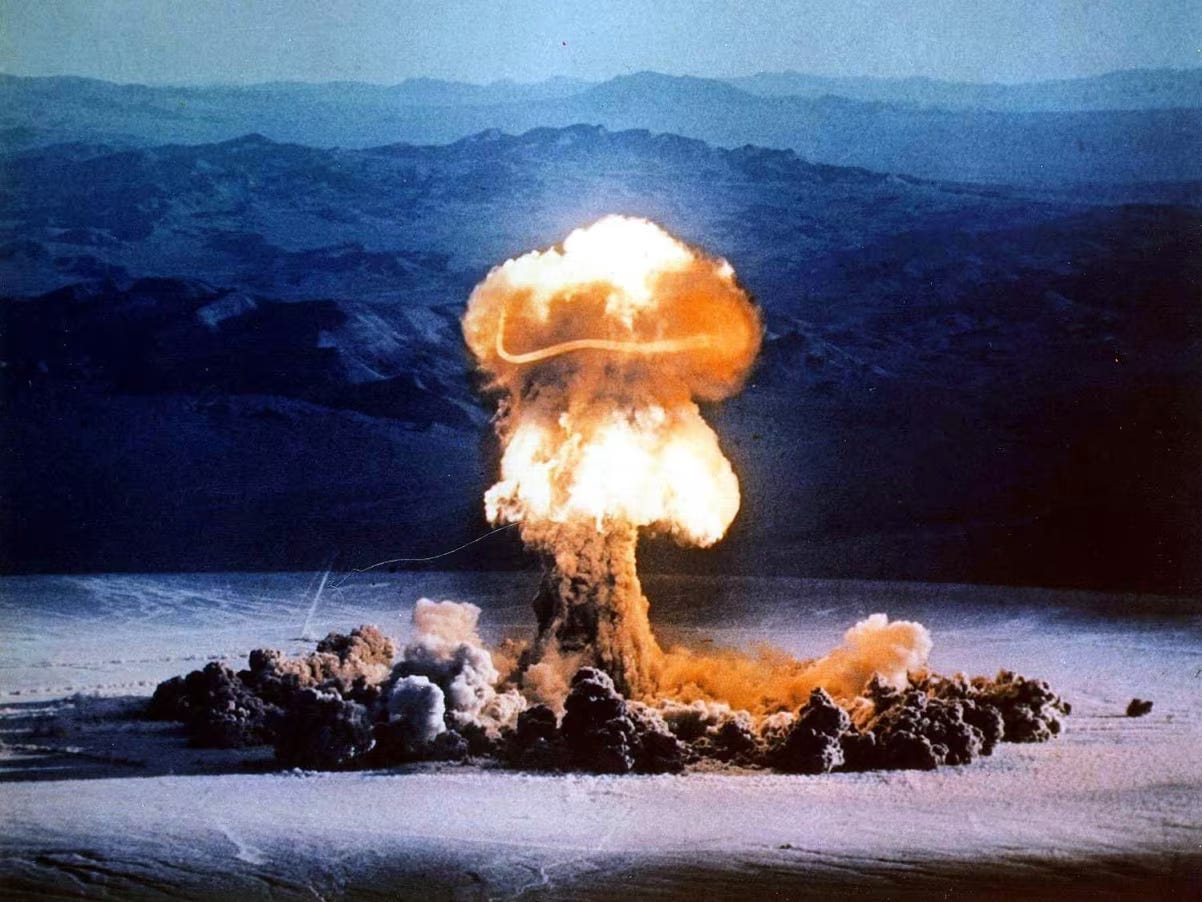
Photo: US Energy Department
Overview
Date: October 30 - November 2, 2025
Summary: President Trump announced his order for the United States to immediately resume nuclear weapons testing, citing testing programs by other countries like Russia and China. This declaration sparked widespread confusion and concern among nuclear experts and officials. Energy Secretary Chris Wright later clarified that the ordered tests would involve “noncritical explosions” or “systems tests” of nuclear weapon components, not full nuclear detonations. Experts cautioned that resuming any form of testing could destabilize global nonproliferation efforts and potentially benefit adversaries by providing a pretext for them to advance their own less-developed nuclear programs.
Sources
The New York Times - New Weapons Testing Won’t Include Nuclear Explosions, Energy Secretary Says
CNN - Trump says he wants to resume nuclear testing. Here’s why experts are confused
The Washington Post - Trump energy secretary says no nuclear explosions for now
The Wall Street Journal - Trump’s Vow to Resume Nuclear Tests Leaves Experts Puzzled
Fox News - Trump says US will restart nuclear weapons tests, blames rivals’ actions after Xi meeting
Key Points
President Trump issued a directive via Truth Social and subsequent remarks, ordering the United States military to resume nuclear weapons testing “immediately” and “on an equal basis” with other countries.
The stated rationale for resuming testing was the perceived testing programs of other nations, specifically Russia and China, which Trump claimed were conducting nuclear tests.
U.S. Energy Secretary Chris Wright clarified that the planned tests would not involve nuclear explosions but rather “noncritical explosions” or “systems tests” to ensure components of nuclear weapons are functioning correctly and to improve replacement warheads.
Experts and officials expressed confusion and concern over Trump’s announcement, questioning his understanding of current nuclear testing practices and the implications of such a move.
There is a general consensus among experts that a return to explosive nuclear testing by the U.S. would destabilize global nonproliferation efforts, potentially prompting other nations to resume or expand their own testing regimes.
The United States has observed a moratorium on explosive nuclear weapons tests since 1992, and such tests are typically overseen by the Department of Energy, not the Department of Defense.
Countries like Russia and China have focused on modernizing their nuclear delivery systems and conducting non-explosive tests, but have not conducted full nuclear detonations in decades.
Unique Highlights
The New York Times highlights that the overall cost of the U.S. program to replace its warheads over three decades is estimated at $1.7 trillion.
CNN quotes Matthew Bunn of Harvard University, who states, “First of all, every statement in that post is wrong,” in response to Trump’s Truth Social post, also clarifying that the Department of Energy, not Defense, carries out nuclear tests
NBC News reports that Brandon Williams, the Trump-appointed head of the National Nuclear Security Administration, testified in April that there was no reason to resume testing, affirming the U.S. stockpile remains safe, secure, and effective without nuclear explosive testing since 1992. This article also mentions that Trump’s directive appears to draw from Project 2025, a conservative blueprint that recommends rejecting the 1996 test-ban treaty.
The Washington Post highlights Trump’s “60 Minutes” interview where he “doubled down on the contention that the U.S. needs to test nuclear weapons,” and insisted, “If we have them, we have to test them, otherwise you don’t really know how they’re gonna work.”
The Wall Street Journal provides details on the New Start treaty, noting its expiration in February and Russia’s offer to extend it. It cites data from the Federation of American Scientists indicating Russia has more nuclear warheads (4,300) than the U.S. (3,700). It also includes Sen. Jack Reed’s concern that U.S. testing would provide justification for Pakistan, India, and North Korea to expand their own testing regimes.
Fox News reports on Trump’s prior warning to Russian President Vladimir Putin about a U.S. nuclear submarine “right off their shores,” made days before the testing announcement, in response to Russia’s missile tests. Trump also hinted at imposing additional sanctions on Russia.
Contrasting Details
Trump’s claims about U.S. nuclear arsenal size vs. expert consensus: President Trump stated in his Truth Social post and to reporters that “The United States has more Nuclear Weapons than any other country” and that Russia is second, with China a “distant third” (Fox News, CNN). However, The Wall Street Journal cites Hans Kristensen of the Federation of American Scientists, who states that “Russia has the world’s largest inventory of nuclear warheads,” with 4,300 weapons compared to the U.S.’s approximately 3,700. CNN also notes Matthew Bunn’s assertion that “It’s not true the United States has the world’s most nuclear weapons.”
Trump’s belief on other countries’ explosive testing vs. expert assessment: Trump repeatedly claimed that “others doing testing” or “they seemed to all be nuclear testing” was a reason for his order (The New York Times, Fox News, NBC News). However, CNN, NBC News, and The Wall Street Journal all cite experts stating that China and Russia have not conducted nuclear explosive tests since the 1990s. CNN quotes Matthew Bunn saying, “It’s not true that other states are carrying out nuclear tests.” The Wall Street Journal notes that U.S. intelligence has assessed Russia might be carrying out small “supercritical tests” with very low explosive power, but these are not full nuclear detonations.
Trump’s understanding of “testing” vs. Energy Secretary’s clarification: Initially, Trump’s statements implied a resumption of nuclear weapons testing broadly, including explosive tests, stating, “If we have them, we have to test them, otherwise you don’t really know how they’re gonna work” (The Washington Post). However, Energy Secretary Chris Wright clarified that the tests would involve “noncritical explosions” or “systems tests” of components, “not nuclear explosions” (The New York Times, The Washington Post). The Wall Street Journal highlights that experts considered whether Trump was referring to missile flight tests rather than nuclear devices.
Trump’s assertion of “immediate” testing vs. logistical realities: Trump’s directive stated the process would “begin immediately” (CNN, NBC News, Fox News). In contrast, NBC News quotes Gregory Jaczko, former chair of the U.S. Nuclear Regulatory Commission, saying, “There is no immediacy when it comes to testing,” and experts estimate it would require hundreds of millions of dollars and at least two years to prepare the Nevada site. The Wall Street Journal also states that a return to nuclear testing “wouldn’t be immediate” and could take two years for a major test or months/a year for supercritical experiments.
The Newsie Project uses AI to summarize, compare, and contrast the reporting of the major US and world online news sources.
This is an evolving project. Tools, approaches, and output formats will change over time. The Newsie Project does not attempt to provide a definitive capsule of any news story. While the incidence of errors in these summaries is low, and I attempt to spot-check details, AI tools can hallucinate. Please click through and read the articles for details (some may be paywalled).