

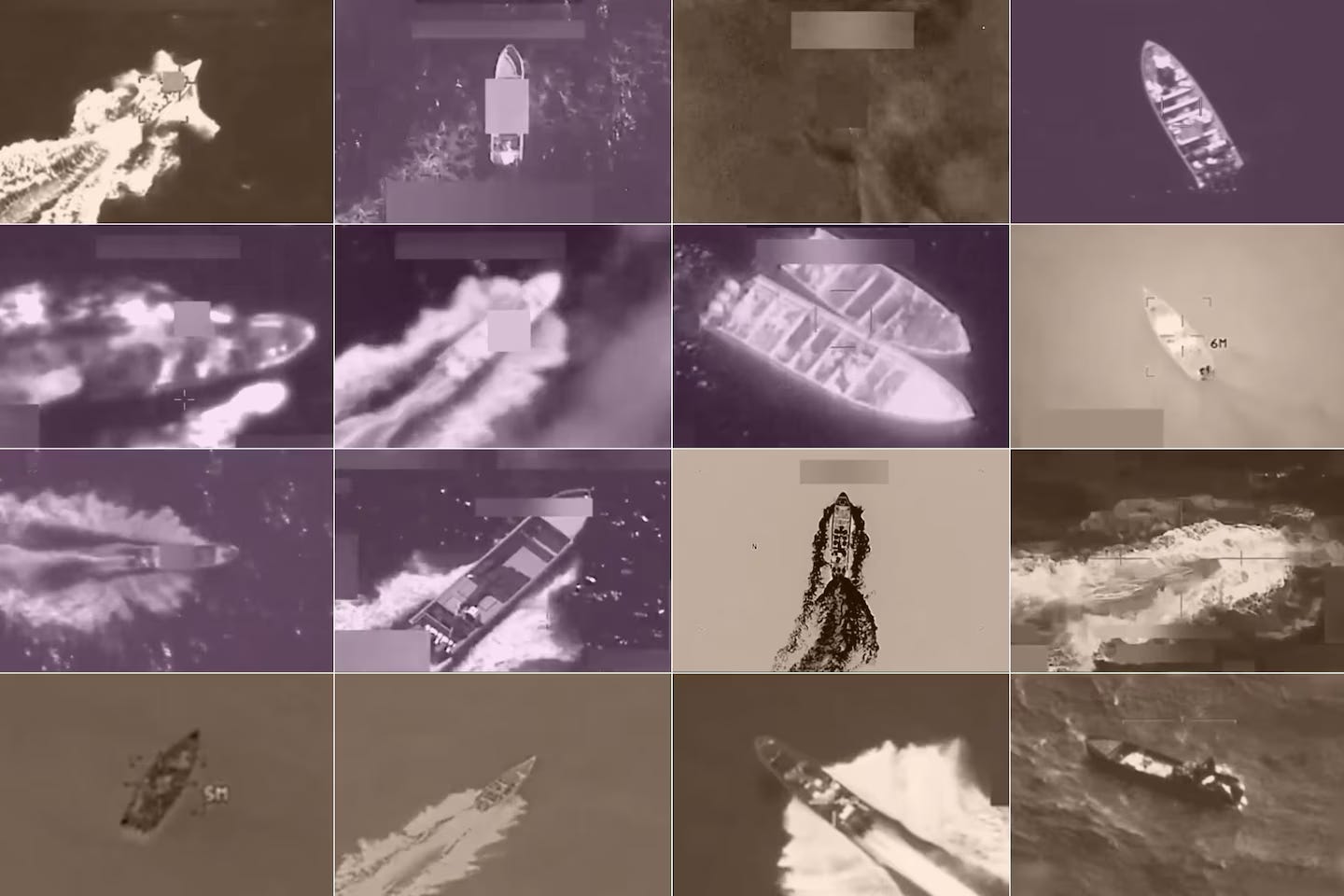
Image: The Washington Post
Overview
Date: November 26-29, 2025
Summary: The US military, under the Trump administration, has conducted over two dozen kinetic strikes on suspected drug boats in the Caribbean and eastern Pacific since early September 2025, resulting in at least 83 deaths. While the administration asserts these actions target drug smugglers and “narco-terrorists” and are lawful, the operations have sparked significant legal, ethical, and congressional concerns. Critics question the legality of killing individuals without clear identification or due process, the destruction of potential intelligence, and the transparency of the military’s actions. Congressional oversight has been initiated, and reports have highlighted a controversial order to “kill everybody” during the initial strike, including survivors.
Sources
The New York Times - What the Pentagon’s Attack Videos Reveal About the Boat Strikes at Sea
The New York Times - Intelligence on U.S. Military’s Boat Strikes Is Limited
The Washington Post - Hegseth order on first Caribbean boat strike, officials say: Kill them all
The Guardian - Pete Hegseth denies that he gave orders to ‘kill everybody’ on alleged ‘narco-boat’
Key Points
The US military has conducted a campaign of kinetic strikes against suspected drug boats in the Caribbean and eastern Pacific since early September 2025.
These operations have resulted in the deaths of over 80 individuals.
The Trump administration justifies the strikes by claiming the targeted individuals are drug smugglers or “narco-terrorists” affiliated with designated terrorist organizations, primarily linked to Venezuela.
The strikes represent a significant departure from traditional counternarcotics efforts, which typically involved interception, boarding, and arrest by law enforcement or the Coast Guard.
The legality of these strikes under US and international law is widely questioned by legal experts, current and former officials, and some lawmakers, who argue they may constitute extrajudicial killings.
There is a notable lack of public evidence from the Pentagon to support claims about the specific identities of those killed or the exact nature of the cargo on each boat.
Congressional oversight has been initiated, with the Senate Armed Services Committee planning investigations into the circumstances of the strikes.
Concerns have been raised about the destruction of intelligence and evidence by blowing up the boats, hindering efforts to dismantle larger drug networks.
Unique Highlights
The New York Times (What the Pentagon’s Attack Videos Reveal About the Boat Strikes at Sea) provides a detailed analysis of the Pentagon’s released videos, identifying specific munitions used such as AGM-176 Griffin missiles, AGM-114 Hellfire missiles, and 250-pound guided glide bombs. It notes the use of AC-130J gunships and MQ-9 Reaper drones and highlights that some videos show boats already stopped at sea with people visible before the strike. The article also mentions a strike on October 22 where a second strike was used to destroy packages floating in the ocean.
The New York Times (Intelligence on U.S. Military’s Boat Strikes Is Limited) focuses on the intelligence aspect, stating that the military does not know specifically who is being killed, often targeting “low-level people” rather than high-ranking cartel leaders. It explains that blowing up boats destroys valuable intelligence and evidence that could be used to dismantle drug networks, contrasting this with traditional intelligence-gathering methods. The article also draws parallels between these strikes and the “signature strikes” of the Obama administration, noting the military’s rejection of this comparison.
CNN (US military carried out second strike killing survivors on a suspected drug boat that had already been attacked, sources say) reports on the September 2 “double-tap” strike, detailing that a second attack was carried out to kill remaining survivors after an initial strike. It clarifies that this is the only known instance where the military deliberately killed survivors, though other boats were hit multiple times to sink them. The article also reveals that Adm. Alvin Holsey, commander of US Southern Command, offered to resign due to concerns about the legality of the strikes and will leave his post in December.
NBC News (Trump says the U.S. will ‘very soon’ take action on land to stop alleged Venezuelan drug traffickers) highlights President Trump’s statement that the US could “very soon” begin targeting alleged Venezuelan drug traffickers on land, expanding operations beyond maritime strikes. It notes the arrival of the USS Gerald R. Ford aircraft carrier in the Caribbean and the designation of the Cartel de los Soles as a foreign terrorist organization. The article also states that drug cartels in the Caribbean primarily transport cocaine to Europe, not the United States.
The Washington Post (Hegseth order on first Caribbean boat strike, officials say: Kill them all) provides a direct account of Defense Secretary Pete Hegseth’s order to “kill everybody” on the first targeted boat on September 2. It names Adm. Frank M. “Mitch” Bradley, then head of Joint Special Operations Command, as the commander who ordered the second strike to comply with Hegseth’s directive. It identifies SEAL Team 6 as having led the attack and discusses the legal argument that killing survivors who are “hors de combat” would be a war crime. The article also mentions that JSOC’s internal reports to the White House and briefings to lawmakers deceptively explained the “double-tap” as an effort to sink the boat as a navigation hazard.
The Guardian (Pete Hegseth denies that he gave orders to ‘kill everybody’ on alleged ‘narco-boat’) specifically covers Defense Secretary Pete Hegseth’s denial of the “kill everybody” order, labeling the reports as “fake news” intended to discredit the military. It cites an Associated Press report that cast doubt on the administration’s claims, revealing that some men killed were running drugs but “not narco-terrorists or leaders of a cartel or gang.”
Contrasting Details
Secretary Hegseth’s Orders Regarding Survivors: The Washington Post explicitly states that Secretary Pete Hegseth gave a direct order to “kill everybody” on the boat during the September 2 strike, and CNN reports that he had ordered the military to ensure everyone was killed. Conversely, The Guardian reports that Hegseth denied these claims, calling them “fake news” and defending the strikes as lawful.
Justification for Killing Survivors: CNN and The Washington Post report that a second strike on September 2 deliberately killed survivors. The Washington Post further details that internal JSOC reports to the White House and briefings to lawmakers explained this “double-tap” as an effort to sink the boat as a navigation hazard, an explanation some members of Congress found deceptive and “patently absurd.”
Identity of Those Killed: The Trump administration consistently claims that those killed are drug smugglers or “narco-terrorists” affiliated with designated terrorist organizations (The New York Times, CNN, NBC News, The Washington Post, The Guardian). However, The New York Times (Intelligence on U.S. Military’s Boat Strikes Is Limited) states the military does not know precisely whom it is killing, suggesting they are low-level individuals or potentially innocent. The Washington Post mentions a DEA official’s assessment that the initial boat’s occupants might have included migrants, and Colombia’s president accused the US of killing an innocent fisherman. The Guardian cites an Associated Press report indicating that while some men were involved in drug running, they were not “narco-terrorists or leaders of a cartel or gang.”
Legality of the Strikes: The Trump administration and Secretary Hegseth maintain that the operations are “lawful under both U.S. and international law” and comply with the law of armed conflict (CNN, The Washington Post, The Guardian). In contrast, multiple sources cite legal experts, former military lawyers, and internal Department of Defense officials who believe the strikes are unlawful, constitute extrajudicial killings, and that an order to kill incapacitated survivors would be a war crime (The New York Times, CNN, The Washington Post, The Guardian). CNN specifically notes that the United Kingdom is no longer sharing intelligence with the US, believing the attacks are illegal.
Destination of Drugs: NBC News reports that drug cartels operating in the Caribbean primarily move cocaine from South America to Europe, not to the United States. This contrasts with the Trump administration’s broader rhetoric, as noted in The Guardian, that the strikes are to stop drugs “poisoning our country” and President Trump’s claim in The New York Times (What the Pentagon’s Attack Videos Reveal…) of hitting a “DRUG-CARRYING SUBMARINE” headed for the United States.
The Newsie Project uses AI to summarize, compare, and contrast the reporting of the major US and world online news sources.
This is an evolving project. Tools, approaches, and output formats will change over time. The Newsie Project does not attempt to provide a definitive capsule of any news story. While the incidence of errors in these summaries is low, and I attempt to spot-check details, AI tools can hallucinate. Please click through and read the articles for details (some may be paywalled).