

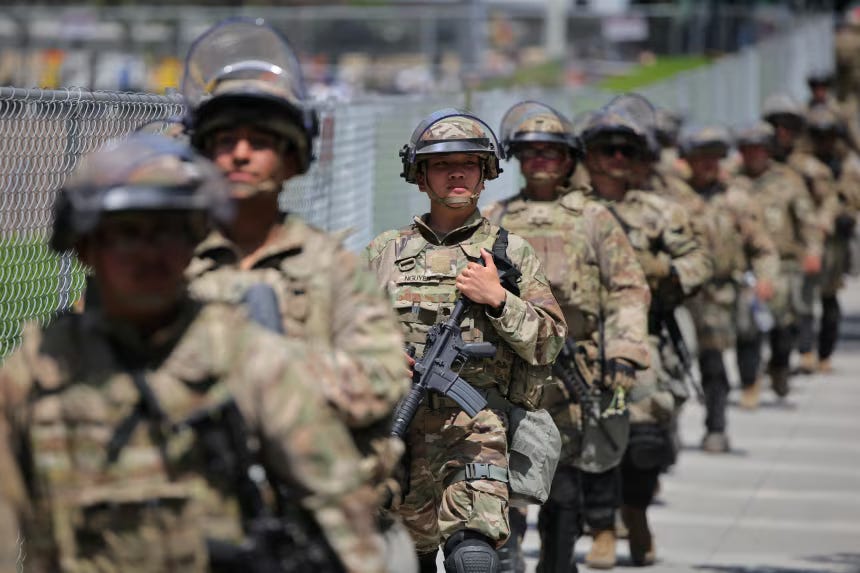
Photo: Daniel Cole/Reuters
Overview
Date: August 23-24, 2025
Topic: Trump Administration’s Expansion of Federal and National Guard Deployments to Combat Crime and Immigration in Major U.S. Cities
Summary: The Trump administration has initiated and planned federal interventions, including National Guard deployments, in major U.S. cities like Washington D.C., Los Angeles, Chicago, and Baltimore, citing high crime rates and immigration concerns. While the administration frames these actions as necessary for law and order, Democratic governors and city mayors strongly oppose them, calling them political stunts, unlawful, and an overreach of federal power.
Sources
The New York Times - In Washington Crackdown, Making a Federal Case Out of Low-Level Arrests
The New York Times - Democrats Criticize Trump’s Push for National Guard in More Cities
The Washington Post - Pentagon plans military deployment in Chicago as Trump eyes crackdown
The Wall Street Journal - Trump Steps Up Feud With Maryland’s Wes Moore
Key Points
President Trump is expanding a federal anti-crime and immigration crackdown, using National Guard and federal law enforcement deployments in major U.S. cities.
Washington D.C. has already experienced a federal takeover, with numerous federal agents and National Guard troops deployed, and U.S. Attorney Jeanine Pirro directing prosecutors to file the most serious federal charges.
The Trump administration is planning similar deployments for Chicago and has floated the idea for Baltimore and New York, linking these efforts to combating crime, homelessness, and undocumented immigration, particularly in “sanctuary cities.”
Democratic governors and mayors of the targeted cities are unified in their strong opposition, viewing these federal actions as politically motivated, unlawful, and an overreach of presidential power.
Local leaders argue that crime rates, particularly homicides, are already declining in their cities and that the federal interventions are unnecessary and could inflame tensions.
The president’s authority to deploy the National Guard without state consent, particularly under Title 10 of the U.S. Code, is a point of contention and legal challenge, as seen in California.
Unique Highlights
The New York Times (In Washington Crackdown, Making a Federal Case Out of Low-Level Arrests) details specific cases in federal court in Washington D.C., such as a man charged with assaulting a federal officer over an open container violation, another with threatening the president after a drunken outburst, and a gun case where prosecutors had Fourth Amendment concerns. It also highlights U.S. Attorney Jeanine Pirro’s directive to charge the most serious crimes possible in federal court and a judge’s exasperation with the prosecutor’s approach.
The New York Times (Democrats Criticize Trump’s Push for National Guard in More Cities) includes specific comments from Rahm Emanuel, former mayor of Chicago, suggesting Trump’s threat is more about animus toward Democratic leadership and a desire to crack down on immigration than a crime strategy. It also mentions Governor Wes Moore of Maryland inviting President Trump for a “safety walk” and President Trump’s subsequent public refusal and criticism.
CNN (Officials have been planning for weeks to send National Guard to Chicago as Trump seeks to expand crime crackdown) explicitly states that the administration’s potential moves in Chicago are expected to resemble the Los Angeles deployment, where President Trump evoked Title 10 of the U.S. Code to deploy troops over the objection of California’s Democratic Governor Gavin Newsom. It also mentions internal discussions about mobilizing active-duty troops from consenting states or using National Guard units from Republican-led states in non-consenting ones.
The Washington Post (Pentagon plans military deployment in Chicago as Trump eyes crackdown)provides detailed context on the legal frameworks, including Title 10 and the Insurrection Act, for deploying military forces domestically. It also cites specific crime statistics, noting that while Chicago has had the most homicides, other cities like St. Louis, Detroit, Baltimore, and D.C. had higher homicide rates last year, and that violent crime in D.C. is down 27 percent. It mentions that the Pentagon said the troops in D.C. will soon be allowed to carry firearms.
The Wall Street Journal (Trump Steps Up Feud With Maryland’s Wes Moore) highlights a personal feud between President Trump and Governor Wes Moore, including President Trump criticizing Governor Moore’s presidential timber and past controversy over a Bronze Star claim, and Governor Moore calling President Trump “President Bone Spurs” in response to his draft deferments. It also mentions President Trump threatening to claw back funding for replacing Baltimore’s collapsed Francis Scott Key bridge.
Contrasting Details
Crime Rates: While President Trump consistently describes cities like Chicago, Baltimore, and Washington D.C. as “crime ridden” and “out of control” to justify federal intervention (The New York Times, The Washington Post, The Wall Street Journal), Democratic leaders and data presented in articles contradict this. Governor J.B. Pritzker of Illinois states crime in Chicago is declining (Fox News), and Governor Wes Moore of Maryland points out that homicides in Baltimore have dropped significantly (The New York Times). The Washington Post notes explicitly that violent crime in D.C. is down 27 percent and homicides are down 11 percent over the previous year.
Communication with Local Leaders: Multiple articles (CNN, Fox News, The Washington Post) report that Chicago Mayor Brandon Johnson and Illinois Governor J.B. Pritzker have not received any official communication from the White House regarding the deployment of the National Guard to Chicago, despite administration plans being in the works for weeks. This contrasts with the federal government’s stated intent to “help” these cities, implying a lack of coordination or consultation.
Motivation for Deployment: The Trump administration, as described across articles, asserts that the deployments are to address crime and lawlessness. However, Democratic leaders offer differing interpretations. Rahm Emanuel, former mayor of Chicago, suggests President Trump’s actions are an attempt to deal with “welcoming cities” (sanctuary cities) and immigration (The New York Times). Lieutenant Governor Juliana Stratton of Illinois accuses President Trump of creating chaos for “more political power” (Fox News). Governor J.B. Pritzker states President Trump is “attempting to manufacture a crisis” and “politicize Americans who serve in uniform” (Fox News, The Washington Post).
The Newsie Project uses AI to summarize, compare, and contrast the reporting of the major US and world online news sources.
This is an evolving project. Tools, approaches, and output formats will change over time. The Newsie Project does not attempt to provide a definitive capsule of any news story. While the incidence of errors in these summaries is low, and I attempt to spot-check details, AI tools can hallucinate. Please click through and read the articles for details (some may be paywalled).