

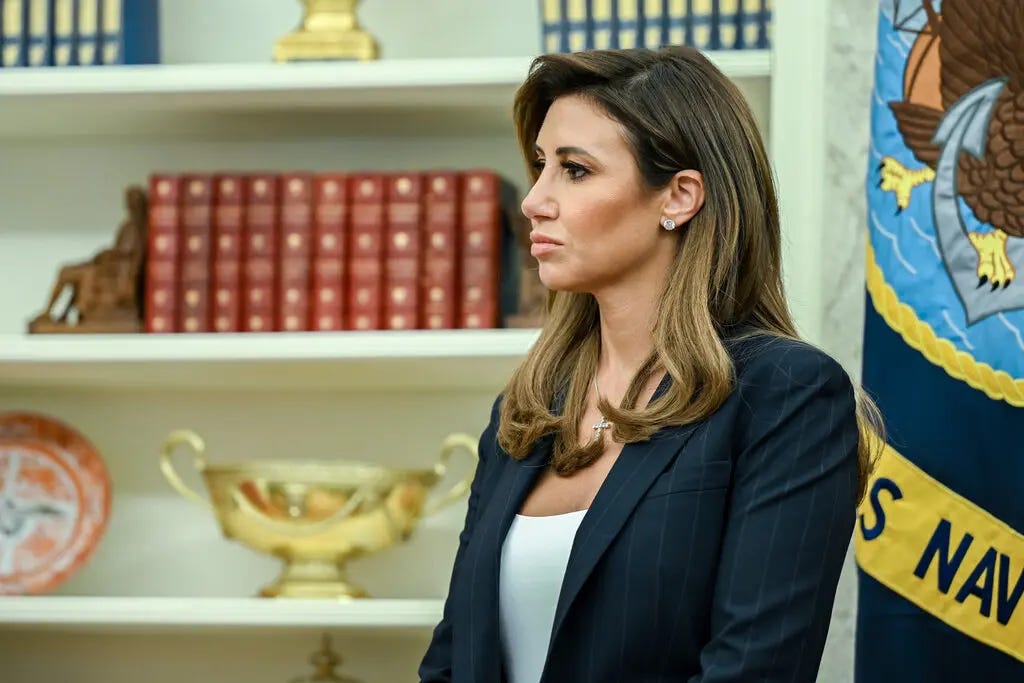
Photo: Kenny Holston/The New York Times
Overview
Date: December 1, 2025
Summary: A federal appeals court unanimously ruled that Alina Habba, former personal attorney to President Donald Trump, was unlawfully serving as the U.S. Attorney for New Jersey. The three-judge panel of the U.S. Court of Appeals for the Third Circuit upheld a lower court’s decision, finding that the Trump administration violated federal law by employing a series of maneuvers to install Habba without Senate confirmation or proper judicial appointment. This decision, which affirms that the administration circumvented constitutional processes, is seen as a significant blow to the Trump administration.
Sources
The New York Times - Appeals Court Says Alina Habba Is Unlawful U.S. Attorney
The Washington Post - Appeals court rules Trump prosecutor appointment violates law
Key Points
All articles report that a federal appeals court (the U.S. Court of Appeals for the Third Circuit) unanimously ruled that Alina Habba’s appointment as the U.S. Attorney for New Jersey was unlawful.
The ruling upholds a lower court’s decision and concludes that the Trump administration’s tactics to keep Habba in the role violated the Federal Vacancies Reform Act (FVRA) and circumvented constitutional appointment processes.
The core issue cited across all sources is that Habba was neither confirmed by the Senate nor properly appointed by district trial court judges, the two traditional pathways for such a position.
The administration’s maneuvers involved appointing Habba for an interim 120-day term, attempting a permanent nomination that failed due to Senate opposition, and then, after New Jersey judges appointed another prosecutor, Attorney General Pam Bondi fired the appointed prosecutor and reinstalled Habba by designating her as “special attorney” and “first assistant U.S. attorney” to grant her acting authority. The court found these maneuvers unlawful.
The decision is framed as a significant legal blow to the Trump administration, with all sources noting its potential for far-reaching implications for other similar interim U.S. attorney appointments nationwide.
Several articles highlight that Habba, a former personal lawyer to President Trump, lacked prior criminal law experience before her appointment.
The ruling follows similar challenges and defeats for the administration regarding other U.S. attorney appointments, notably Lindsey Halligan in the Eastern District of Virginia, which led to the dismissal of criminal cases against James Comey and Letitia James.
While the court found Habba’s appointment unlawful, most articles state that the appeals court, like the lower court, did not dismiss the criminal cases she oversaw in New Jersey, distinguishing them from the Halligan cases, where the prosecutor personally presented the indictments.
The Justice Department is expected to consider appealing the decision, potentially to the U.S. Supreme Court.
Unique Highlights
The New York Times specifically names New Jersey Democratic Senators Cory Booker and Andy Kim as opposing Habba’s nomination and mentions the 11th Circuit Court of Appeals upholding nearly $1 million in penalties against President Trump and Ms. Habba for filing “frivolous” lawsuits against political enemies. This article also identifies Cesar Humberto Pina as a specific defendant whose lawyers challenged Habba’s authority.
CNN quotes the unanimous panel stating, “Under the Government’s delegation theory, Habba may avoid the gauntlet of presidential appointment and Senate confirmation and serve as the de facto U.S. Attorney indefinitely. This view is so broad that it bypasses the constitutional (appointment and Senate confirmation) process entirely.” The article also points out that the ruling could specifically impact appointments in the Los Angeles and Las Vegas areas.
NBC News names Judge Cameron Currie as the federal judge who dismissed criminal indictments against James Comey and Letitia James due to Lindsey Halligan’s unlawful appointment, noting Halligan had “no prior prosecutorial experience.”
The Washington Post specifies that President Joe Biden appointed Judge L. Felipe Restrepo, while Judges D. Brooks Smith and D. Michael Fisher were appointed by President George W. Bush. It also notes that, in the New Jersey cases, career prosecutors handled the cases under Habba’s supervision, unlike the Halligan cases, where Ms. Halligan personally presented the cases to a grand jury. The article also mentions Habba represented President Trump in a defamation suit brought by E. Jean Carroll.
The Wall Street Journal mentions that a federal judge in October ruled that Bill Essayli, President Trump’s pick to lead the U.S. attorney’s office in Los Angeles, was unlawfully serving, and a Nevada judge issued a similar ruling in September. This article also states two specific reasons the court found Habba couldn’t serve: because President Trump had previously nominated her for the permanent position, and because she wasn’t serving as first assistant when the U.S. attorney post became vacant.
Contrasting Details
There are no direct discrepancies, differing interpretations, or conflicting information between the articles. All sources consistently report the same core facts regarding the appeals court’s ruling, the reasons for it, and the broader context of similar appointments.
The Newsie Project uses AI to summarize, compare, and contrast the reporting of the major US and world online news sources.
This is an evolving project. Tools, approaches, and output formats will change over time. The Newsie Project does not attempt to provide a definitive capsule of any news story. While the incidence of errors in these summaries is low, and I attempt to spot-check details, AI tools can hallucinate. Please click through and read the articles for details (some may be paywalled).