

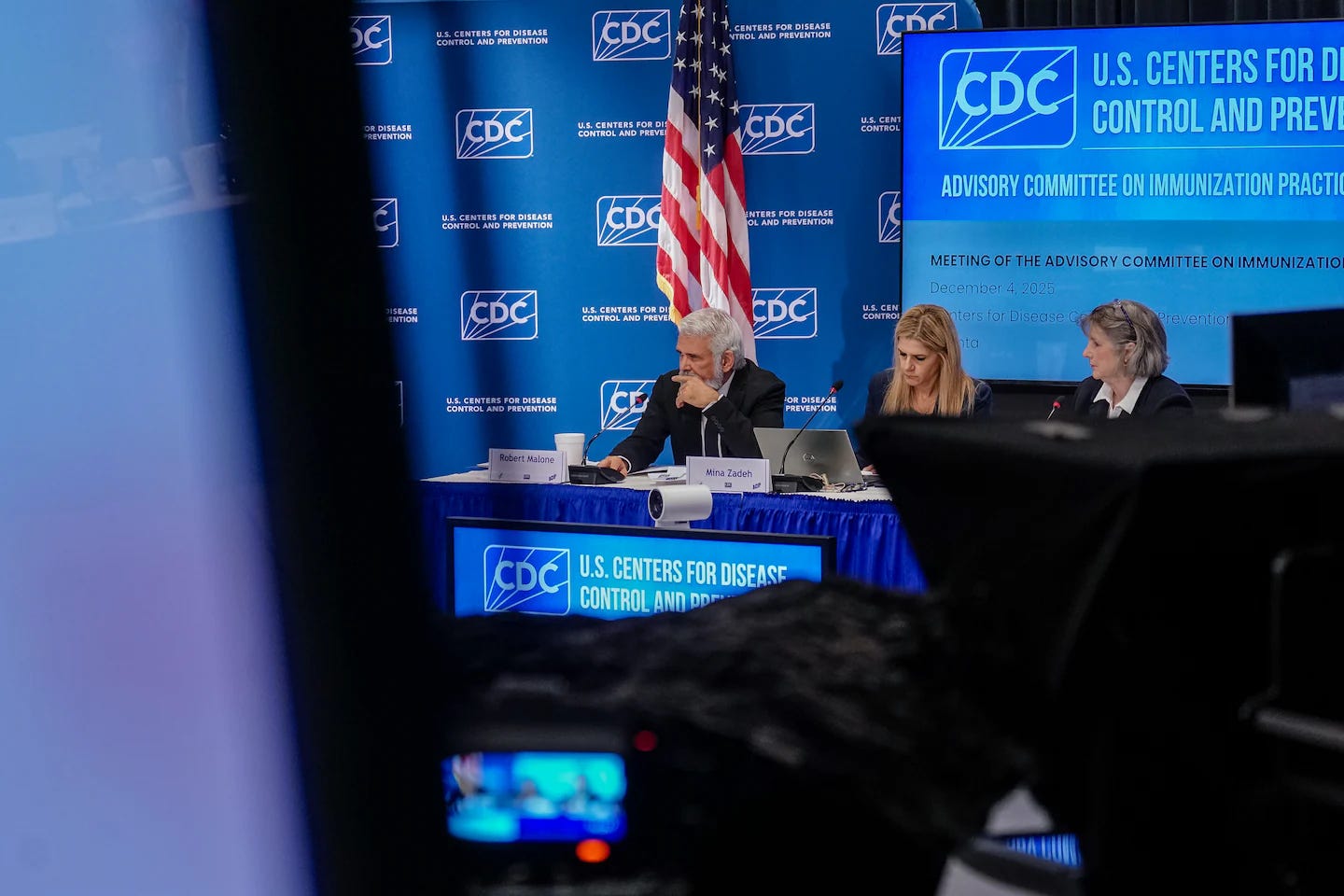
Photo: Elijah Nouvelage
Overview
Date: December 5, 2025
Summary: A federal vaccine committee, the Advisory Committee on Immunization Practices (ACIP), voted to end the decades-long recommendation for universal hepatitis B vaccination at birth for newborns of mothers who test negative for the virus. The panel, whose members were appointed by Health Secretary Robert F. Kennedy Jr., now suggests “individual-based decision-making” in consultation with healthcare providers and delaying the first dose until at least two months of age. This decision has sparked widespread criticism from public health experts and medical organizations, who warn of increased hepatitis B infections, erosion of vaccine confidence, and the politicization of public health guidance.
Sources
The New York Times - Panel Votes to End Recommendation for Hepatitis B Shots for All Newborns
CNN - CDC advisers vote in support of major change to childhood vaccination
NBC News - CDC advisory panel rolls back universal hepatitis B vaccine recommendation
The Washington Post - CDC panel makes most sweeping revision to child vaccine schedule under RFK Jr.
The Wall Street Journal - CDC Panel Remade by RFK Jr. Votes to Alter Hepatitis B Vaccine Guidance
Key Points
The Advisory Committee on Immunization Practices (ACIP) voted 8-3 to eliminate the universal recommendation for a hepatitis B birth dose for newborns of mothers who test negative for the virus.
The new guidance recommends “individual-based decision-making” in consultation with a healthcare provider for parents deciding on the hepatitis B vaccine for HBsAg-negative newborns, suggesting the initial dose be administered no earlier than 2 months of age if not given at birth.
The committee also voted to recommend that parents and providers consider post-vaccination antibody testing to assess immunity before administering subsequent doses, with insurance coverage for such tests.
Health Secretary Robert F. Kennedy Jr. appointed the current ACIP members after firing the previous members, and the new panel largely reflects his skepticism about vaccines.
Public health experts, medical organizations, and some dissenting ACIP members strongly oppose the change, warning that it will lead to an increase in hepatitis B infections, liver disease, and undermine trust in vaccines.
Critics argue the decision lacks scientific evidence, disregards data supporting the vaccine’s effectiveness, and politicizes public health policy.
The acting CDC director is tasked with making the final decision on whether to adopt these new recommendations.
The universal hepatitis B birth dose, recommended since 1991, has been credited with significantly reducing hepatitis B infections among children in the United States.
Unique Highlights
The New York Times provides a detailed graphical breakdown of the revised childhood vaccine schedule, illustrating specific changes to the timing and inclusion of various vaccine doses. It also highlights Dr. Joseph Hibbeln’s strong objection to the vote language being in its “fourth iteration in 96 hours” and the lack of data supporting the 2-month delay or the antibody test.
CNN reports that Health Secretary Robert F. Kennedy Jr.’s press office directed the ACIP meeting to be produced with a “C-Span-type atmosphere” from a television studio, a departure from traditional conference room settings. It also details ACIP member Dr. Evelyn Griffin’s suggestion of a link between “profound autism” and vaccination, contrasting it with scientific consensus, and provides an in-depth explanation of aluminum adjuvants in vaccines, affirming their safety based on broad scientific evidence.
NBC News notes that Acting CDC Director Jim O’Neill is a former investment executive without a medical background. It also mentions that Food and Drug Administration Commissioner Marty Makary stated the evidence does not support a universal birth dose for hepatitis B and that parents could wait until a child is 8, 10, or 12 years old without scientific evidence of a benefit from earlier vaccination.
The Washington Post recounts an overheard exchange where ACIP Chair Kirk Milhoan expressed feeling “like a little bit like puppets on a string” regarding the panel’s work, though he later denied pressure from Kennedy. The article also mentions that attorney Aaron Siri’s presentation lasted more than 90 minutes.
The Wall Street Journal identifies specific ACIP members (Vicky Pebsworth, Cynthia Nevison, Mark Blaxill) and their affiliations with anti-vaccine organizations. It also highlights Dr. Evelyn Griffin’s claim that the vaccine could lead to autoimmune conditions, acknowledging a lack of high-quality studies to support this. The article clarifies that federal insurance programs will continue to cover the birth dose, but private insurers in some states might drop coverage.
Contrasting Details
Necessity and Efficacy of Universal Birth Dose: Public health experts and medical groups, including the American Academy of Pediatrics, the American Medical Association, and the Hepatitis B Foundation, consistently argue that the universal hepatitis B birth dose is crucial for preventing infection, especially given that many infected individuals are unaware of their status and transmission can occur through household objects. They warn that the change will lead to an increase in infections, liver disease, and cancer, as stated by The New York Times, CNN, NBC News, The Washington Post, and The Wall Street Journal. Conversely, ACIP panelists who voted for the change, such as Retsef Levi (The New York Times, The Washington Post), argue the universal recommendation for HBsAg-negative mothers is overly broad and unnecessary due to the low risk of infection in early childhood. Food and Drug Administration Commissioner Marty Makary, as reported by NBC News, explicitly states that evidence does not support a universal birth dose and suggests waiting years would not diminish its benefit, a view also echoed by Dr. Tracy Beth Hoeg of the FDA in The Wall Street Journal.
Scientific Basis and Credibility of ACIP: Many sources highlight a stark contrast in perceptions of the committee’s scientific integrity. Dr. Paul Offit and Dr. Peter Hotez, prominent vaccine experts, declined invitations to present, calling the ACIP a “parody of a public health agency” and a “font of misinformation” that has “shifted its mission away from science and evidence-based medicine,” according to The New York Times and CNN. Dr. Joseph Hibbeln and Dr. Cody Meissner, dissenting ACIP members, explicitly stated that the committee was making decisions without sufficient data or debate, with Dr. Hibbeln calling aspects “unconscionable” and Dr. Meissner describing recommendations as “making things up” and “like Never Never Land” (The New York Times, CNN, NBC News, The Wall Street Journal). In contrast, ACIP Chair Kirk Milhoan, while acknowledging “pressures from many organizations,” maintained that the panel was trying to look at data (The Washington Post).
Comparison of US and Danish Vaccination Schedules: Dr. Tracy Beth Hoeg (FDA) suggested that the change aligns the US with “peer nations” like Denmark that do not recommend routine birth doses (CNN, The Wall Street Journal). However, Dr. Adam Langer, the CDC’s hepatitis B expert, strongly countered this comparison, stating that Denmark and most other high-income countries are not “peer nations” due to significant differences in population size, rates of prenatal screening for hepatitis B, free prenatal care access, national health registries, and follow-up systems for infected mothers and infants (CNN, The Wall Street Journal).
Link Between Vaccines and Autism: ACIP member Dr. Evelyn Griffin suggested that “profound autism” may be linked to vaccination (CNN, The Wall Street Journal). This is directly contradicted by scientific groups like the Autism Science Foundation, which states, “The science is clear that vaccines do not cause autism,” and by ACIP member Dr. Cody Meissner, who cited the debunked claims of Andrew Wakefield and emphasized that research has found no association (CNN, NBC News).
The Newsie Project uses AI to summarize, compare, and contrast the reporting of the major US and world online news sources.
This is an evolving project. Tools, approaches, and output formats will change over time. The Newsie Project does not attempt to provide a definitive capsule of any news story. While the incidence of errors in these summaries is low, and I attempt to spot-check details, AI tools can hallucinate. Please click through and read the articles for details (some may be paywalled).