

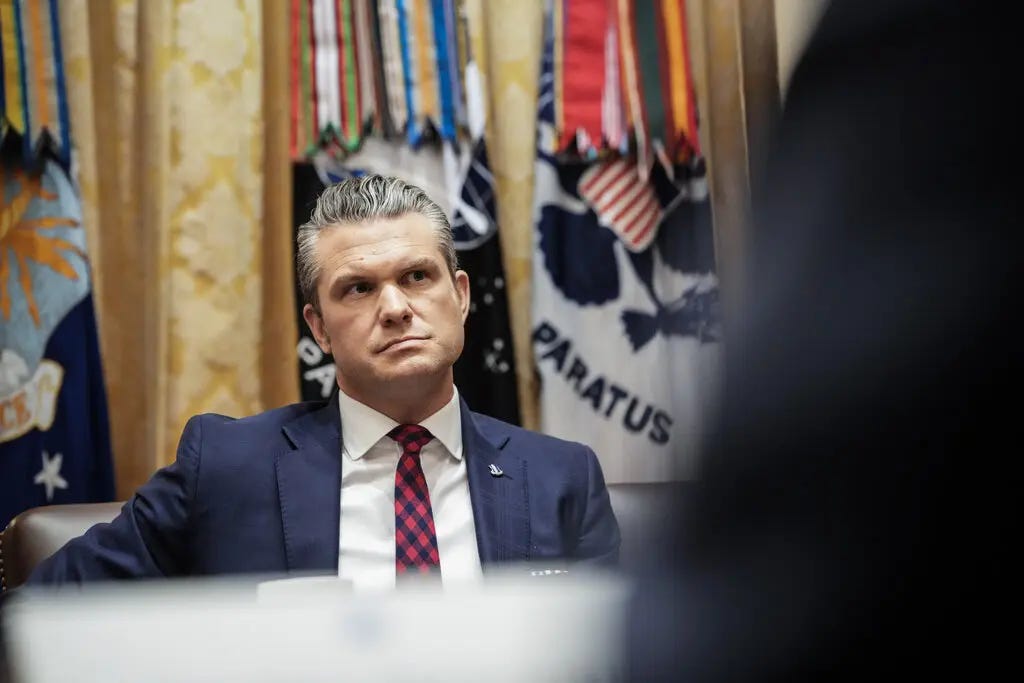
Photo: Doug Mills/The New York Times
Overview
Date: December 6-7, 2025
Topic: Controversy and Accountability Surrounding Trump Administration’s Lethal Strikes on Alleged Drug Boats
Summary: The Trump administration faces intense scrutiny over its military campaign against alleged drug-smuggling boats, particularly a September 2, 2025, incident where a second strike killed survivors of an initial attack. Defense Secretary Pete Hegseth and Adm. Frank Bradley have defended the actions, citing the survivors’ continued threat and their presence on a military target list. However, lawmakers and legal experts question the legality and ethics, with some calling for the release of classified video footage and an investigation into potential war crimes or extrajudicial killings. The debate also extends to the broader use of military force without congressional approval and the applicability of international and military law.
Sources
CNN - Trump is immune from accountability for boat strikes. What about everyone under him?
NBC News - Sen. Tom Cotton says survivors of first September boat strike ‘were not incapacitated’
NBC News - Admiral told lawmakers everyone on alleged drug boat was on a list of military targets
The Wall Street Journal - Hegseth Defends Pentagon Strike on Drug-Boat Survivors
Key Points
All articles address the intense controversy surrounding the September 2, 2025, military strike on an alleged drug boat, specifically the second strike that killed survivors of the initial attack.
Defense Secretary Pete Hegseth and Adm. Frank Bradley consistently defend the second strike as lawful and necessary, arguing the individuals on board were legitimate military targets.
A central point of contention is whether the survivors of the first strike were incapacitated or continued to pose a threat, thus justifying the follow-up lethal action.
Lawmakers, particularly Democrats, are actively calling for the public release of classified video footage of the Sept. 2 strike to provide transparency and allow for public judgment.
The targeted vessels are uniformly described as alleged drug-smuggling boats, often associated with designated foreign terrorist organizations or cartels, as claimed by the administration.
The Sept. 2 incident is part of a broader Trump administration military campaign involving numerous strikes on alleged drug boats, which have resulted in a significant number of fatalities.
Adm. Frank Bradley provided briefings to congressional intelligence and armed services committees to explain the details and rationale behind the Sept. 2 operation.
Unique Highlights
CNN provides a detailed breakdown of the complex legal landscape for accountability, discussing presidential immunity, military law, civilian law, and international law, as well as the US stance on the International Criminal Court. It also reports that SEAL Team Six carried out the strike and cites a former military lawyer, Maj. Gen. Steven Lepper, who argues the laws of war do not apply as the US is not at war, rendering the military’s overall use unlawful. The article mentions a Colombian family’s complaint to the Inter-American Commission on Human Rights regarding the death of Alejandro Carranza.
NBC News (Sen. Tom Cotton) features Sen. Tom Cotton’s specific defense that survivors “were not incapacitated” but “sitting on that boat” and “clearly moving around,” possibly trying to flip the boat to rescue cargo or signal. It also highlights Sen. Cotton’s argument that President Trump does not require congressional approval for these continued strikes under the War Powers Resolution. Additionally, Sen. Adam Schiff’s characterization of the strikes as “unlawful” and “a form of extrajudicial killing” is detailed.
NBC News (Admiral told lawmakers) reveals that Defense Secretary Pete Hegseth ordered the military to kill all 11 people on the boat because they were on an “internal list of narco-terrorists” eligible for lethal targeting. It specifies that Adm. Frank Bradley ordered third and fourth strikes because the boat did not sink after the second. The article details the initial strike used a GBU-69 precision-guided munition set to air burst and Bradley’s observation of survivors for over 30 minutes, noting they appeared uninjured and were able to flip the boat. It also states that U.S. intelligence indicated the drugs were heading to Suriname, then Europe or Africa, not the U.S.
The Wall Street Journal reports Defense Secretary Pete Hegseth’s first detailed public remarks on the operation at the Reagan National Defense Forum, where he stated he left the room five minutes after the first strike and was later informed about the second. It also mentions that Hegseth is under fire in a Pentagon inspector general review for sharing sensitive information about a Yemen operation on Signal. The article notes Bradley’s testimony that a surveillance drone detected no other boats in the immediate vicinity during the second strike.
The New York Times quotes Representative Adam Smith stating it was “simply not accurate” that the video showed survivors attempting to flip the boat to continue trafficking, and that the video is “very, very difficult to justify.” Representative Jim Himes is quoted as saying survivors “were barely alive, much less engaging in hostilities” and “barely hanging on,” also expressing doubt that the administration knew the identity of all 11 people killed. The article highlights Hegseth’s hesitation to release the video due to not wanting to “compromise sources and methods,” contrasting with President Trump’s willingness.
Contrasting Details
Condition and Intent of Survivors: Sen. Tom Cotton (NBC News) asserted that the survivors were “not incapacitated,” “sitting on that boat,” and “clearly moving around,” possibly attempting to rescue cargo or signal. Conversely, Representative Adam Smith (The New York Times) stated it was “simply not accurate” that the video showed survivors trying to flip the boat to continue trafficking. Representative Jim Himes (The New York Times) described the survivors as “barely alive, much less engaging in hostilities” and “barely hanging on.”
Order to Kill Everyone: Defense Secretary Pete Hegseth (The Wall Street Journal, The New York Times) explicitly denied giving a “spoken directive to kill everyone aboard,” calling a prior Washington Post report “patently ridiculous.” However, Adm. Frank Bradley (NBC News) informed lawmakers that he received orders from Hegseth to kill all individuals on an approved target list, which included everyone on the boat, though Bradley clarified he was not given an illegal “no quarter order.”
Destination of Drugs: Sen. Tom Cotton (NBC News) stated that the intelligence briefing did not reveal whether the boat was headed to the U.S., implying it was irrelevant to the targeting decision. In contrast, Adm. Frank Bradley (NBC News) told lawmakers that U.S. intelligence indicated the drugs were heading south to Suriname, then ultimately to Europe or Africa, not the U.S.
Presence of Other Vessels: Adm. Frank Bradley (The Wall Street Journal) testified that a surveillance drone detected no other boats in the immediate vicinity during the second strike, although he speculated survivors might have been signaling. However, Adm. Frank Bradley (NBC News) also explained his decision was partly influenced by U.S. intelligence spotting another larger boat in the area with which the damaged boat was supposed to link up.
Release of Video Footage: President Trump (The New York Times) stated he would have “no problem” releasing the classified video. Defense Secretary Pete Hegseth (The Wall Street Journal, The New York Times) was noncommittal, citing a review process and potential compromise of “sources and methods.” Representative Adam Smith (The New York Times) dismissed Hegseth’s reasoning, arguing the video was no different from others the Defense Department had released.
The Newsie Project uses AI to summarize, compare, and contrast the reporting of the major US and world online news sources.
This is an evolving project. Tools, approaches, and output formats will change over time. The Newsie Project does not attempt to provide a definitive capsule of any news story. While the incidence of errors in these summaries is low, and I attempt to spot-check details, AI tools can hallucinate. Please click through and read the articles for details (some may be paywalled).