

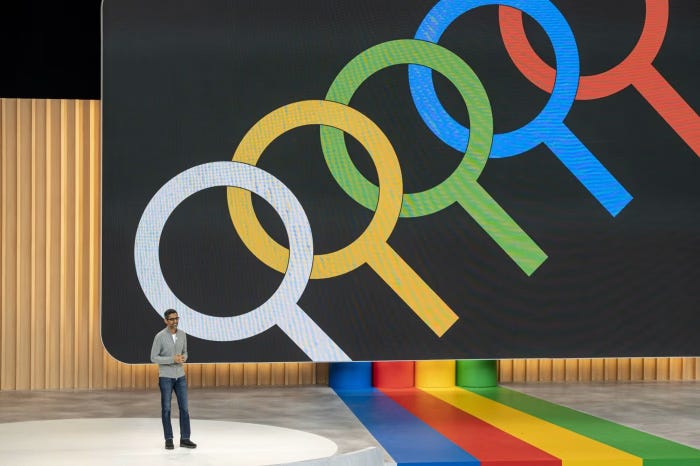
Photo: David Paul Morris/Bloomberg News
Overview
Date: September 2, 2025
Summary: A federal judge has ruled on the remedies for Google’s illegal monopoly in online search, largely rejecting the government’s more aggressive proposals. While Google will not be forced to sell its Chrome browser or Android operating system, it is barred from entering exclusive contracts for default search placement and must share certain search data with competitors. The decision, significantly influenced by the rapid rise of generative AI, is widely seen as a win for Google, though the Justice Department is evaluating its next steps.
Sources
The New York Times - Judge Orders Google to Share Search Results to Help Resolve Monopoly
The Wall Street Journal - Google Dodges Worst Penalties in U.S. Antitrust Case
NBC News - U.S. judge orders Google to share search data with competitors
The Washington Post - Judge bars Google from exclusive search deals but says it can keep Chrome
Key Points
U.S. District Judge Amit P. Mehta ruled that Google must share certain search results and some data with qualified rival companies.
The judge rejected the Justice Department’s request to force Google to sell its Chrome web browser and Android operating system.
Google is now barred from entering into or maintaining exclusive contracts that make its product the automatic default search engine on web browsers and smartphones, including for its Gemini AI assistant.
The ruling allows Google to continue making payments to device manufacturers and browser developers for prime placement of its search engine, as long as these deals are not exclusive.
The emergence and rapid development of generative artificial intelligence heavily influenced Judge Mehta’s decision, as he stated it “changed the course of this case” and could introduce new competition to search.
The decision is largely viewed as a significant win for Google, leading to an increase in its stock price and that of Apple.
The remedies ordered by the court will apply for six years.
This ruling is a landmark decision that will set a precedent for other ongoing antitrust cases against major tech companies like Apple, Amazon, and Meta.
Unique Highlights
The New York Times notes that Google’s stock price shot up about 8 percent in after-hours trading and that Google paid $26.3 billion for distribution deals in 2021. It quotes DuckDuckGo CEO Gabriel Weinberg calling the data-sharing requirements a “nothingburger” and Rebecca Haw Allensworth on the unpredictable impacts of antitrust decisions.
CNN specifies that the ban on exclusive contracts extends to the Google Assistant and its Gemini app, and highlights that Google had previously proposed ditching some of these contracts as a potential remedy. It also mentions a “far-fetched offer” by Perplexity to buy Chrome.
The Wall Street Journal emphasizes that Wall Street analysts scored the ruling as a “huge win” for both Google and Apple, allowing their existing multi-billion dollar arrangement for default search placement to continue. It also references testimony where an Apple executive reported Google searches in Safari had fallen for the first time in two decades and that Apple would likely offer AI options like ChatGPT or Perplexity in Safari.
NBC News states that Google CEO Sundar Pichai expressed concerns during the trial that data-sharing measures could enable rivals to reverse-engineer its technology. It also mentions specific device makers (Samsung Electronics, Motorola) and wireless carriers (AT&T, Verizon) whose recent deals allow rival search offerings.
The Washington Post points out that the judge also declined the Justice Department’s request to require Google to present users with a “choice screen” to pick a different search engine, or to share granular advertising data, or to fund a national public education campaign. It highlights Judge Mehta’s reasoning that the DOJ had not met the “heavy burden” for a “radical structural” remedy and that the last major company ordered to split up under Section 2 of the Sherman Act was AT&T in 1984. It also mentions Google executives seeking lighter regulation from the (returning) Trump administration due to competition with China.
Contrasting Details
While all articles generally describe the ruling as a “win” for Google, there are differing interpretations of its effectiveness in promoting competition. The Washington Post describes the ruling as a “marked setback to government efforts to aggressively rein in the giants of Silicon Valley” and quotes Gene Kimmelman calling it a “disappointingly weak remedy.” In contrast, The Wall Street Journal and CNN present it as a “significant win” for Google, with The New York Times quoting Bill Baer saying it’s “certainly better than the worst-case scenario.”
The Justice Department’s immediate response to the ruling varies across sources. CNN and The Washington Post state that the Justice Department did not immediately respond to requests for comment. However, The New York Times quotes Gail Slater of the Justice Department saying the agency would “consider the department’s options and next steps regarding seeking additional relief,” and The Wall Street Journal quotes Slater stating the government was “studying whether Mehta’s decision goes far enough.”
Regarding Google’s intent to appeal, The New York Times states Google “had planned to appeal,” and NBC News mentions Google “said previously that it plans to file an appeal.” The Washington Post clarifies that Google is “still appealing the original decision that found it was an illegal monopoly” and has denied wrongdoing, indicating their appeal targets the initial monopoly finding rather than the specific remedies of this latest ruling.
The Newsie Project uses AI to summarize, compare, and contrast the reporting of the major US and world online news sources.
This is an evolving project. Tools, approaches, and output formats will change over time. The Newsie Project does not attempt to provide a definitive capsule of any news story. While the incidence of errors in these summaries is low, and I attempt to spot-check details, AI tools can hallucinate. Please click through and read the articles for details (some may be paywalled).