

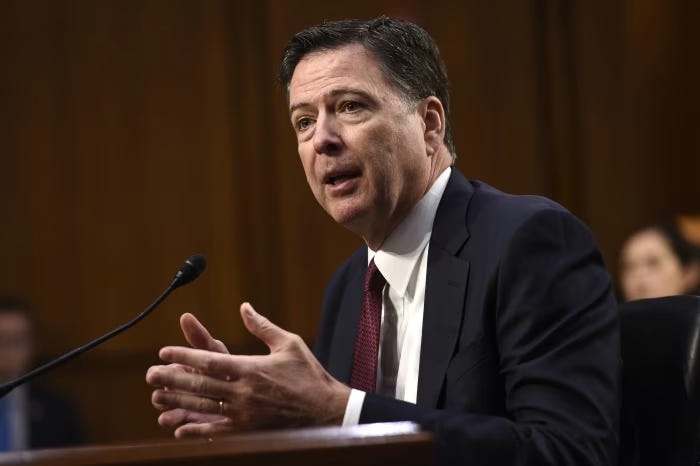
Photo: Saul Loeb/AFP
Overview
Date: September 25, 2025
Summary: Former FBI Director James Comey was indicted on September 25, 2025, on two felony counts of making a false statement and obstruction of a congressional proceeding. The charges stem from his 2020 testimony regarding whether he authorized leaks about 2016 FBI investigations. This indictment is widely perceived as a direct act of retribution by President Donald Trump against a perceived political enemy, fulfilling his campaign promise of payback. The case was brought by Lindsey Halligan, a Trump loyalist appointed shortly before the statute of limitations expired, despite objections from career prosecutors within the Justice Department. Comey denies the charges and intends to challenge them in court, while critics argue the actions undermine the independence of the Justice Department and established democratic norms.
Sources
NBC News - Former FBI Director James Comey indicted following pressure from Trump
The Washington Post - With Comey prosecution, Trump fulfills promise of revenge
The New York Times - Grand Jury Indicts Longtime Trump Target, Former F.B.I. Director James Comey
The New York Times - Trump Gets the Retribution He Sought, and Shatters Norms in the Process
CNN - What to know about the James Comey indictment and what happens next
The Wall Street Journal - James Comey Indicted on False Statement Charges
Key Points
James Comey was indicted on two felony counts: making a false statement and obstruction of a congressional proceeding, stemming from his September 2020 testimony.
The charges relate to Comey’s alleged authorization of an unnamed person to be an anonymous source in news reports regarding an FBI investigation while he was FBI Director.
The indictment is widely interpreted as a fulfillment of President Trump’s promise of retribution against perceived political adversaries, particularly those involved in investigations against him.
Lindsey Halligan, a Trump loyalist and former personal lawyer, was appointed acting U.S. Attorney for the Eastern District of Virginia shortly before the indictment and personally presented the case to the grand jury.
The indictment was brought days before the five-year statute of limitations for the alleged crimes was set to expire.
Career prosecutors within the Justice Department expressed concerns about the sufficiency of evidence to support charges against Comey.
Comey has denied the charges, declared his innocence, and stated his intention to go to trial.
Critics argue that Trump’s actions and the manner of the indictment represent a dangerous politicization of the Justice Department, eroding norms of independence established after the Watergate scandal.
Unique Highlights
CNN (Tracking Trump’s retaliation) provides a broader overview of President Trump’s retribution agenda, detailing other targets beyond Comey, including John Bolton, Kamala Harris, Gen. Mark Milley, New York Attorney General Letitia James, Jack Smith, National Archives leadership, FEMA officials, January 6 prosecutors, Miles Taylor, Chris Krebs, and various Justice Department and NOAA officials. It also extensively lists numerous former government officials, including former President Joe Biden, who have had their security clearances revoked.
NBC News specifies that the Justice Department inspector general’s report in 2018 found Andrew McCabe made misleading statements but concluded that the “overwhelming weight of evidence supported Comey’s version” regarding Comey not authorizing McCabe’s leak. The article also notes the rarity of convictions for lying to Congress, citing Michael Cohen and Roger Stone as recent examples. It details the resignation of Comey’s son-in-law, Troy Edwards, as a federal prosecutor.
The Washington Post quotes historian Timothy Naftali, who contrasts Trump’s approach with Richard Nixon’s, stating Trump makes “no such pretense” of justice being blind. It also highlights Trump’s previous use of executive orders to punish law firms he disfavored.
The New York Times (Grand Jury Indicts Longtime Trump Target, Former F.B.I. Director James Comey) reveals that the grand jury rejected one of the charges prosecutors sought against Comey (a second false statement charge related to Hillary Clinton in 2016). It also describes Judge Lindsey R. Vaala’s confusion over the multiple charging documents and the unusual late hour of the grand jury proceedings. The article mentions internal justifications for placing the investigation in Virginia, including Comey testifying remotely from Virginia and an unsubstantiated theory about classified documents at an FBI storage facility in Winchester.
The New York Times (Trump Gets the Retribution He Sought, and Shatters Norms in the Process) emphasizes the “break-glass moment” for the Justice Department. It draws detailed comparisons between the Comey indictment and Trump’s own indictments, highlighting that President Joseph R. Biden Jr. did not publicly demand Trump’s prosecution or appoint personal lawyers, and Trump’s cases were handled by independent special counsel or local prosecutors with longer investigations and judicial review.
Fox News quotes FBI Director Kash Patel defending the bureau’s work in the case, dismissing claims of politicization as “wildly false accusations” and “hypocrisy on steroids,” stating the bureau is “precisely over the target.”
The Wall Street Journal specifically identifies the 2016 episode that Senator Ted Cruz questioned Comey about: Andrew McCabe providing information to The Wall Street Journal about an FBI investigation into the Clinton Foundation. It notes that prosecutors in Trump’s first term investigated McCabe but did not charge him.
Contrasting Details
NBC News and The Wall Street Journal reference a 2018 Justice Department inspector general’s report concerning a leak by Andrew McCabe. NBC News states this report concluded that “the overwhelming weight of evidence supported Comey’s version of the conversation and not McCabe’s” regarding Comey authorizing the leak. This appears to conflict with the core allegation in the indictment that Comey “had in fact authorized” an anonymous source, as reported by CNN, The New York Times, and The Wall Street Journal.
CNN (What to know about the James Comey indictment…) and The New York Times (Grand Jury Indicts Longtime Trump Target…) both report that the grand jury rejected one of the charges prosecutors sought against Comey (a second false statement related to Hillary Clinton in 2016). This indicates a partial disagreement or lack of sufficient evidence for that specific count within the grand jury, suggesting not all prosecutorial requests were accepted.
Fox News quotes FBI Director Kash Patel defending the bureau’s work, dismissing claims of politicization as “wildly false accusations” and “hypocrisy on steroids,” asserting the investigation was legitimate. This directly contrasts with the interpretation in CNN, NBC News, The Washington Post, and The New York Times articles, which broadly characterize the indictment as a politically motivated act of retribution by President Trump, undermining Justice Department independence and established norms.
The Newsie Project uses AI to summarize, compare, and contrast the reporting of the major US and world online news sources.
This is an evolving project. Tools, approaches, and output formats will change over time. The Newsie Project does not attempt to provide a definitive capsule of any news story. While the incidence of errors in these summaries is low, and I attempt to spot-check details, AI tools can hallucinate. Please click through and read the articles for details (some may be paywalled).