

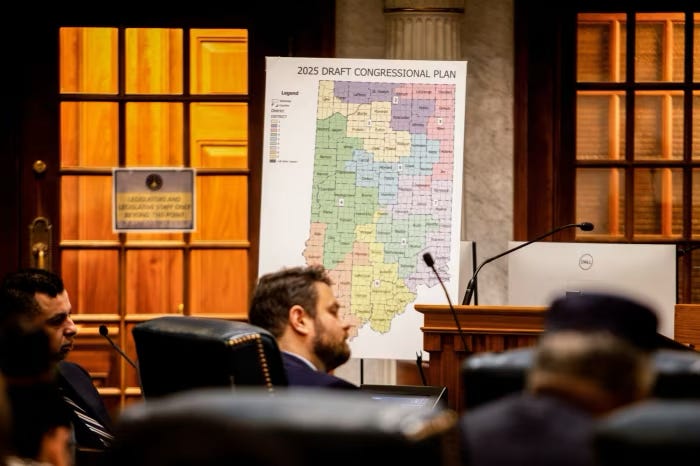
Photo: Kaiti Sullivan/Bloomberg News
Overview
Date: December 11, 2025
Summary: The Indiana Senate, with a Republican supermajority, voted 31-19 to reject a plan to redraw the state’s congressional districts, delivering a significant political defeat to former President Donald Trump. Trump and his allies had launched an intense, months-long pressure campaign, including threats of primary challenges and high-profile visits, to push for the mid-cycle redistricting. The vote limits potential Republican gains in the national redistricting efforts championed by Trump and highlights the limits of his influence within parts of his party.
Sources
The New York Times - Indiana Lawmakers Reject Trump’s New Political Map
CNN - Indiana Senate Republicans reject Trump’s redistricting push
The Wall Street Journal - Indiana Redistricting Plan Rejected in Rebuke to Trump
NBC News - Indiana Senate rejects GOP-drawn congressional map in a major rebuke of Trump
Key Points
The Indiana Senate rejected a Trump-backed plan to redraw congressional districts with a 31-19 vote, marking a rare and public defeat for President Trump.
Twenty-one Republican senators joined ten Democrats in opposing the proposed map.
Trump and his allies, including Vice President JD Vance, House Speaker Mike Johnson, and various conservative groups, exerted significant pressure on Indiana lawmakers through phone calls, White House invitations, visits to the state, and social media posts.
The pressure campaign included threats of primary challenges against Republican senators who opposed the redistricting plan.
Several lawmakers, both for and against the map, reported receiving violent threats, bomb threats, and becoming victims of swatting incidents amidst the debate.
The proposed map aimed to position Republicans to sweep all nine of Indiana’s U.S. House seats, flipping the two currently held by Democrats.
Opposing senators cited concerns about the constitutionality of mid-cycle redistricting, maintaining the integrity of elections, avoiding outside interference from Washington D.C., and reflecting the will of their constituents.
Supporters of the map argued it was necessary to bolster Republican voices in Congress and offset gerrymandering by Democrats in other states.
The rejection in Indiana is seen as a blow to Trump’s broader national campaign to redraw congressional maps in Republican-led states ahead of the 2026 midterm elections, which typically occurs only after the decennial U.S. census.
Unique Highlights
The New York Times quotes State Senator Greg Walker, a Republican who called the bill “unconstitutional,” and State Senator Spencer Deery, another Republican, who stated, “it’s time to say no to pressure from Washington, D.C.” and “outsiders who are trying to run our state.” The article also notes Governor Mike Braun’s statement expressing disappointment and his intent to work with the president to “challenge these people.” It mentions that Kansas Republicans rejected a similar Trump-backed plan and that Maryland Democrats were divided over remapping, with the Democratic governor of Illinois considering redrawing if Indiana had proceeded.
CNN details that Vice President JD Vance made two visits to Indiana, and state lawmakers were invited to the White House as part of the lobbying effort. Republican Senator Greg Goode criticized “over-the-top pressure from inside the Statehouse and outside,” as well as “threats of violence, acts of violence,” and reported “overwhelming feedback” from his constituents to oppose the effort. Senator Liz Brown, a pro-redistricting Republican, explicitly stated that passing new maps “actually is about trying to predetermine political outcomes — absolutely. It’s a privilege policy-makers have.”
The article names specific groups involved in the pressure campaign: Club for Growth, Turning Point USA, and a new group led by veteran Indiana Republican operative Marty Obst. Donald Trump Jr. also threatened to campaign against opposing senators, and Vance accused Senate Leader Rodric Bray of dishonesty.
The Wall Street Journal reports that cheers erupted in the chamber when the vote ended. It provides context on other states’ actions, noting Texas lawmakers redrew their map to gain five seats, North Carolina and Missouri redrew for one seat each, and California approved a plan for five additional Democratic seats, which the Justice Department is seeking to block. It also mentions Virginia Democrats considering remapping. The article specifies that Republican state Senate Leader Rodric Bray had stated his caucus preferred to win elections under the current map.
The Washington Post highlights State Senator Vaneta Becker’s 44 years in Indiana’s legislature and her direct refusal to Trump’s request during a White House call. Becker is quoted as saying, “Hoosiers bristle at meddling from Washington.” The article notes that 19 GOP senators previously voted with Democrats to end a legislative session without acting on redistricting.
It provides a detailed account of State Senator Greg Goode’s swatting incident, where police kicked in his door and pointed guns at him after a false report.
The article mentions State Senator Travis Holdman declining a White House invitation and State Senator Sue Glick noting Indiana’s 209th anniversary of joining the Union on the day of the vote. It also details State Senator Mike Bohacek’s strong opposition after Trump’s use of a derogatory term, linking it to his daughter with Down syndrome, and State Representative Ed Clere’s belief that the resistance stems from “Indiana’s DNA” of independence.
NBC News specifies that GOP leaders of Indiana’s Senate had long resisted the mid-decade redistricting battle due to a lack of support. It clarifies that Bray is one of 11 Republicans who won’t be on the ballot until 2028, while the other 10 will face re-election in 2026.
The article details specific threats, including State Representative Tim Yocum receiving a pipe bomb threat, and Senators Michael Crider and Dan Dernulc receiving the same threat. Dernulc also reported being swatted twice and having pizzas repeatedly sent to his home, leading to a police car being stationed outside for his family’s safety, and stated, “I don’t want to be killed.” Senator Greg Goode’s floor speech is quoted: “I’m a Christian first, then an American, then a conservative, then a Republican — in that order.”
Fox News states that the districts of Democratic Representatives Frank Mrvan and Andre Carson would have been eliminated by the proposed map. The article notes that the redistricting bill passed the Indiana House 57-41 with a dozen GOP lawmakers voting against it, and that the State Senate had previously split 19-19 in a proxy vote last month. It also mentions Trump’s social media post from the weekend before the vote, highlighting nine undecided state Senate Republicans who “need encouragement to make the right decision.”
The article provides context that Ohio’s new map will boost Republicans but not as much as some Democrats feared. Missouri opponents submitted thousands of petition signatures for a statewide referendum, and a Utah district judge rejected a GOP map, creating a Democratic-leaning district.
Contrasting Details
There are no direct contradictions in factual reporting across the articles regarding the vote count, the outcome, or the general timeline of events.
However, the articles vary in their emphasis on the motivations behind the Republican opposition. The New York Times and The Washington Post emphasize constitutional concerns, local independence, and rejection of “outsiders” or “meddling from Washington, D.C.” CNN highlights constituent feedback and the explicit admission by a pro-redistricting senator that it was about predetermining political outcomes. NBC News focuses heavily on the violent threats and swatting incidents as a factor influencing some senators’ resolve.
While all articles acknowledge the pressure from Trump and his allies, The Washington Post and NBC News provide more detailed accounts of specific threats and intimidation tactics, including particular swatting incidents and bomb threats, and their impact on individual lawmakers.
The broader national context of redistricting efforts is covered with varying detail. The Wall Street Journal, Fox News, and The Washington Post offer more extensive lists of other states that have either adopted new maps (Texas, North Carolina, Missouri) or are considering them (Virginia, Florida, Kansas) and counter-efforts by Democrats (California, Illinois, Maryland, Utah, Missouri referendum).
The Newsie Project uses AI to summarize, compare, and contrast the reporting of the major US and world online news sources.
This is an evolving project. Tools, approaches, and output formats will change over time. The Newsie Project does not attempt to provide a definitive capsule of any news story. While the incidence of errors in these summaries is low, and I attempt to spot-check details, AI tools can hallucinate. Please click through and read the articles for details (some may be paywalled).