

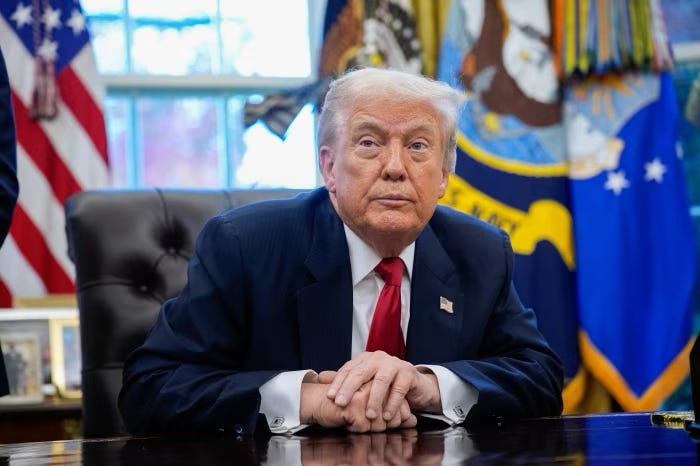
Photo: Yuri Gripas – Pool via CNP/Zuma Press
Overview
Date: November 26, 2025
Summary: The Georgia election interference case against President Donald Trump and his co-defendants was dismissed on November 26, 2025, by Judge Scott McAfee following a motion from prosecutor Peter Skandalakis. This decision effectively ends the last major criminal prosecution against Trump related to his efforts to overturn the 2020 election, after similar federal cases were previously dropped. Skandalakis cited the impracticality of prosecuting a sitting president, the lengthy timeline required for trial, and resource constraints as key reasons. Trump and his defense team celebrated the dismissal, characterizing the case as a politically motivated “witch hunt” or “lawfare.”
Sources
The New York Times - Judge Dismisses Georgia Election Interference Case Against Trump
CNN - Georgia prosecutor kills the historic election interference case against Trump and allies
The Washington Post - Georgia prosecutor ends 2020 election interference case against Trump, allies
The Wall Street Journal - Georgia Judge Drops Election-Interference Case Against Trump
Key Points
The Georgia election interference case against President Donald Trump and his co-defendants was dismissed by Fulton County Superior Court Judge Scott McAfee.
The dismissal followed a motion filed by Peter Skandalakis, the prosecutor who assumed responsibility for the case after the original prosecutor, Fulton County District Attorney Fani Willis, was disqualified.
Skandalakis cited the impracticality of prosecuting a sitting president due to potential immunity issues, the lengthy timeline (estimated five to ten years) needed to bring the case to trial, and the significant burden and cost on the state and Fulton County as primary reasons for the dismissal.
The case, a sprawling racketeering (RICO) indictment, centered on allegations that Trump and 18 co-defendants conspired to unlawfully overturn the 2020 presidential election results in Georgia.
A key piece of evidence was Trump’s January 2021 phone call with Georgia Secretary of State Brad Raffensperger, in which Trump urged him to “find” enough votes to reverse his loss.
Donald Trump and his defense counsel celebrated the dismissal, with Trump calling it an “unAmerican hoax” or “witch hunt” and his lawyer characterizing it as an end to “political persecution” or “lawfare.”
The dismissal extends to Trump’s co-defendants, including Rudolph W. Giuliani and Mark Meadows, though some co-defendants had previously entered plea deals.
This dismissal signifies the end of the last major criminal prosecution against Trump related to his 2020 election overturning efforts, following the earlier dropping of federal election interference and classified documents cases after his re-election.
Unique Highlights
The New York Times highlighted that state criminal convictions are not subject to presidential pardons, making the Georgia case a particularly serious legal threat to Trump. The article also mentions the Justice Department under Trump is investigating Fani Willis, scrutinizing a trip she took to the Bahamas, and that Trump has directed the department to pursue retribution against perceived personal enemies. It notes Skandalakis’s call for more legal scrutiny of alleged crimes against election worker Ruby Freeman, suggesting prosecution in Cobb County.
CNN reported that Skandalakis considered severing Trump’s case from his co-defendants but deemed it “illogical and unduly burdensome and costly.” The article quotes Skandalakis’s personal reflection: “The case ‘is on life support… I have no emotional connection to this case.’” It also details that four of the 19 defendants accepted plea deals and that thirty “unindicted co-conspirators” were named.
NBC News specified that Skandalakis’s decision was made “to serve the interests of justice and promote judicial finality.” The article mentions Skandalakis’s criticism of some of Giuliani’s conduct, stating that while he was “reluctant to criminalize the act of attorneys providing flawed legal advice,” those lawyers should be accountable to their state bars. It also notes Skandalakis took the case himself after all other contacted prosecutors declined.
The Washington Post stated that Trump was convicted on New York hush-money charges but “received no penalty in a sentencing held after he was reelected.” It also reported Skandalakis’s additional reasoning that his agency “is simply not equipped to carry out this case while meeting the essential duties required under the current budget.” The article detailed the specifics of Trump’s call to Raffensperger, including Trump telling him, “There’s nothing wrong with saying, you know, that you’ve recalculated.”
The Wall Street Journal quoted Skandalakis stating, “I begin the process of evaluating this case with a basic truth: It is not illegal to question or challenge election results.” It also quoted Anthony Michael Kreis, a Georgia State University law professor, who suggested the decision might have rested more on practical reasons than legal strategy, and that “Had this evidence been allowed to go forward… there would have been a very, very strong case…” The article also highlighted Fani Willis’s defiant courtroom testimony: “These people are on trial for trying to steal an election in 2020. I’m not on trial, no matter how hard you try to put me on trial.”
Contrasting Details
Interpretation of Trump’s Call with Raffensperger:
The New York Times and The Washington Post both reported Skandalakis’s view that “reasonable minds could differ” on interpreting Trump’s call with Brad Raffensperger, suggesting an alternative interpretation that Trump genuinely believed fraud had occurred. The New York Times directly contrasted this with Raffensperger’s unequivocal statement in his 2021 book that “the president was asking me to do something that I knew was wrong.”
Skandalakis’s Stance on 2020 Election Fraud Claims:
CNN stated that “Skandalakis emphasized that the 2020 election results were valid and gave no credence to Trump’s claims of voter fraud.” However, The New York Times and The Washington Post reported Skandalakis’s suggestion that Trump might have genuinely believed fraud occurred, which could be interpreted as a degree of consideration for the premise of Trump’s claims, rather than giving “no credence.”
Appropriate Venue for Election Interference Cases:
The New York Times, NBC News, and The Washington Post reported Skandalakis’s conclusion that the federal inquiry by Special Counsel Jack Smith was the more appropriate venue for an investigation of Trump’s attempts to stay in power. In contrast, The Wall Street Journal quoted Georgia State University law professor Anthony Michael Kreis arguing that “States are important safeguards to ensure presidents can’t engage in conspiracies to keep themselves in power…”
Outcome of New York Hush-Money Case Sentencing:
The Washington Post stated that Trump “received no penalty in a sentencing held after he was reelected” for his New York hush-money conviction. The Wall Street Journal mentioned Trump is appealing his 34-count-felony conviction but did not specify the sentencing outcome.
The Newsie Project uses AI to summarize, compare, and contrast the reporting of the major US and world online news sources.
This is an evolving project. Tools, approaches, and output formats will change over time. The Newsie Project does not attempt to provide a definitive capsule of any news story. While the incidence of errors in these summaries is low, and I attempt to spot-check details, AI tools can hallucinate. Please click through and read the articles for details (some may be paywalled).