

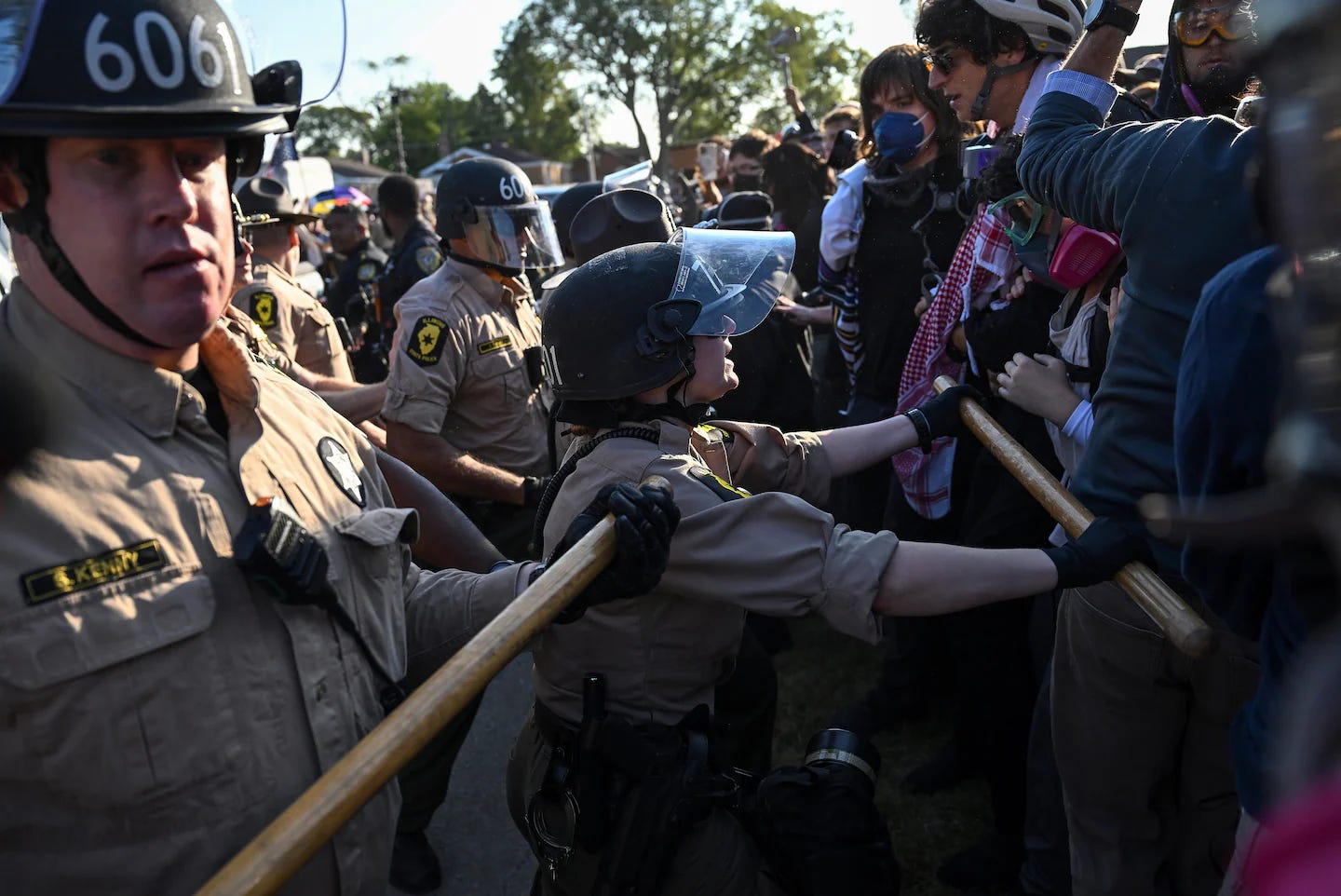
Photo: Joshua Lott/The Washington Post
Overview
Date: October 6, 2025
Summary: President Trump’s administration is facing widespread legal challenges and strong opposition from Democratic-led states and cities over its efforts to deploy National Guard troops to urban centers like Chicago and Portland, Oregon. Citing concerns about crime, immigration enforcement, and protecting federal assets, Trump has ordered the federalization of state National Guard units, often against the will of state governors. Federal judges have issued rulings blocking these deployments, prompting Trump to threaten the use of the Insurrection Act to bypass judicial and gubernatorial resistance. The deployments have sparked intense debates over federal overreach, the constitutional authority of the president, and the appropriate role of the military in domestic affairs.
Sources
NBC News - Illinois sues the Trump administration over National Guard deployment to Chicago
The Washington Post - Trump’s use of Guard may have lasting impact on cities and troops
The Wall Street Journal - Illinois Sues to Block Trump’s National Guard Deployment
CNN - Legal battles erupt over White House’s moves to deploy National Guard to Portland and Chicago
Key Points
Presidential Authority and Federalization: President Trump is actively deploying or threatening to deploy National Guard troops to several U.S. cities, primarily Democratic-led, by federalizing state Guard units.
Justifications for Deployment: The administration justifies these deployments by alleging ongoing violent riots, lawlessness, the need to protect federal officers and assets, and to enforce federal immigration laws.
Widespread Legal Challenges: States and cities, including Illinois and Oregon, are filing lawsuits to block these deployments, arguing that they are unconstitutional, an abuse of power, and an illegal intrusion into state sovereignty.
Judicial Intervention: Federal judges have issued temporary restraining orders blocking the deployment of National Guard troops, particularly in Portland, citing a lack of significant violence or disruption to justify military intervention.
Threat of Insurrection Act: President Trump has stated he is considering invoking the Insurrection Act to bypass court orders and gubernatorial objections if deployments continue to be blocked.
Concerns Over Misuse of Military: Experts and local officials express deep concerns about the potential misuse of the National Guard for political purposes, its impact on troop readiness and morale, and the erosion of public trust in communities where law enforcement is already mistrusted.
Focus on Chicago and Portland: Chicago and Portland, Oregon, are central to the current legal and political battles, with federal deployments and state lawsuits specifically targeting these cities.
Specific Incidents in Chicago: Recent confrontations in Chicago involving federal agents and motorists, including a shooting, are highlighted as examples of escalating tensions.
Unique Highlights
The New York Times provides detailed insight into Judge Karin Immergut’s conservative background and her past work, including questioning Monica Lewinsky during the Ken Starr investigation, emphasizing her apolitical judicial approach despite being a Trump appointee. The article further clarifies that a federal judge previously ruled Trump’s 2020 Los Angeles National Guard deployment illegal under the Posse Comitatus Act.
NBC News references a 2013 tweet by Trump (“we need our troops on the streets of Chicago, not in Syria”) to demonstrate his long-standing hostility towards Chicago and its leaders.
The Washington Post notes that some Republican governors, such as Tennessee’s Bill Lee and Louisiana’s Jeff Landry, have welcomed Trump’s efforts, with Landry requesting up to 1,000 Guard troops for New Orleans and other cities. It details the specific duties of Guard troops in past deployments, such as detaining people in Los Angeles and “beautification” tasks in Washington, D.C. The article also quotes Stephen Miller and Pam Bondi’s aggressive rhetoric in Memphis, promising to “liberate” the city from crime, and references the 1970 Kent State University shooting as a historical cautionary tale. It cites a CBS News/YouGov poll indicating 58% of Americans oppose Trump’s deployments.
The Wall Street Journal reveals President Trump’s social media post showing Chicago in flames with himself as Lt. Col. Bill Kilgore from “Apocalypse Now,” captioned “Chipocalypse Now,” as evidence of his “longstanding hostility.” It also highlights Chicago Mayor Brandon Johnson’s executive order prohibiting the use of city property for federal immigration operations, explicitly stating, “Our school parking lots are not for ICE to load their weapons.” The article mentions Illinois Governor Pritzker’s direct request to Texas Governor Greg Abbott to prevent Texas National Guard deployment to Illinois.
Fox News features Chicago Police Superintendent Larry Snelling’s strong public statement denying “stand down” orders for his officers and warning that ramming law enforcement vehicles would be considered deadly force, justifying a deadly response. It also mentions Fox News’s acquisition of a dispatch log that appears to contradict Snelling’s denial of a “stand down” order.
CNN provides quotes from Portland residents directly disputing Trump’s descriptions of chaos, with one saying, “There are no fires, there’s no lynching, there’s no rioting, there’s no looting, there’s no attacks or assaults.” It also includes a statement from Major General Randy Manner, a retired National Guard official, who calls the administration’s justifications for deployments “lies” and describes Trump’s actions as an attempt to “normalize the intimidation of our citizens using our military.”
Contrasting Details
Severity of Protests and Necessity of Deployment:
The New York Times, The Wall Street Journal, and CNN report that federal Judge Karin Immergut, a Trump appointee, found the protests in Portland “were not significantly violent or disruptive” and that Trump’s portrayal of the situation was “simply untethered to the facts.” Portland residents, as quoted by CNN, also strongly dispute Trump’s claims of chaos, stating there are no riots, looting, or fires.
Conversely, the Trump administration, as cited across all articles, maintains that military force is needed to address “ongoing violent riots and lawlessness” and “sustained, violent assemblies” in these cities, and to protect federal assets and agents from “insurrectionists” or “domestic terrorism” (NBC News, The Washington Post, CNN).
Accounts of Chicago Confrontation:
The New York Times highlights discrepancies in the Department of Homeland Security’s initial statement regarding a Saturday confrontation in Chicago, which claimed a driver was “armed with a semiautomatic weapon.” The criminal complaint filed later, however, made no mention of a firearm. The article also presents a conflicting account from the mother of one of the charged motorists, who said her son told her federal agents struck him, rather than the other way around.
Fox News reports Chicago Police Superintendent Larry Snelling’s strong denial of claims that his officers were ordered to “stand down” during incidents involving federal agents, stating it was “absolutely not true.” However, the article also notes that Fox News “previously obtained what appears to be a dispatch log indicating the chief of patrol did appear to order officers to stand down,” directly contradicting Snelling’s public statement.
Legality and Constitutional Basis of Deployments:
Democratic governors (Illinois Gov. JB Pritzker, California Gov. Gavin Newsom, Oregon Gov. Tina Kotek) and the lawsuits filed by Illinois and Chicago, as reported by The New York Times, NBC News, The Washington Post, The Wall Street Journal, and CNN, argue that Trump’s actions are “unconstitutional,” “illegal,” “patently unlawful,” and an “unconstitutional invasion” that infringes on state sovereignty and exceeds presidential authority. Judge Immergut also stated that the arguments made by the Justice Department “risk blurring the line between civil and military federal power.”
The White House, as noted by NBC News, The Washington Post, and The Wall Street Journal, maintains that President Trump’s actions are “lawful” and within his authority to protect federal officers and assets amidst lawlessness. Stephen Miller, as quoted by CNN, asserts that the administration will comply with court rulings but has “many other options” to deploy federal resources.
The Newsie Project uses AI to summarize, compare, and contrast the reporting of the major US and world online news sources.
This is an evolving project. Tools, approaches, and output formats will change over time. The Newsie Project does not attempt to provide a definitive capsule of any news story. While the incidence of errors in these summaries is low, and I attempt to spot-check details, AI tools can hallucinate. Please click through and read the articles for details (some may be paywalled).