

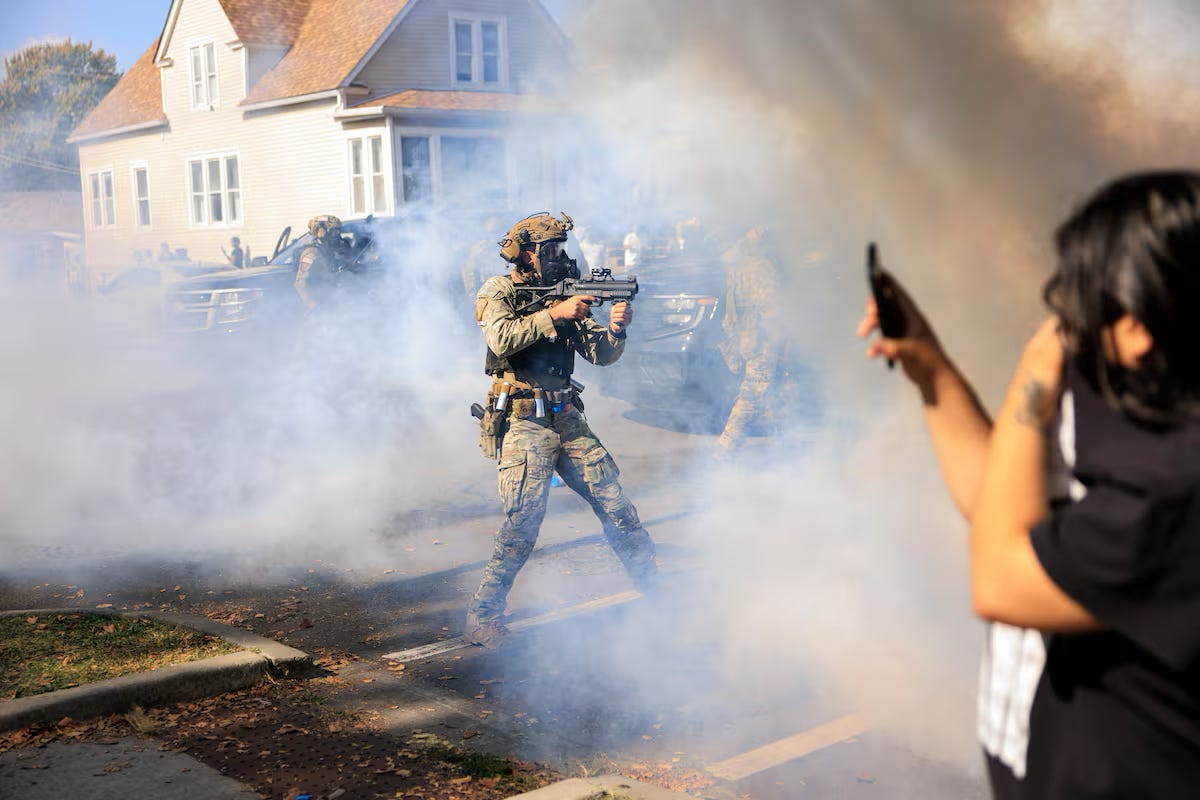
Photo: Anthony Vazquez (AP)
Overview
Date: October 16, 2025
Summary:
On October 16, 2025, federal courts delivered significant setbacks to the Trump administration’s immigration enforcement efforts in Chicago. A federal appeals panel upheld a lower court’s block on deploying National Guard troops, rejecting the administration’s claim of a “rebellion” and stating “political opposition is not rebellion.” Simultaneously, a U.S. District Judge, concerned that federal agents were not following a previous order, expanded her restraining order to mandate body cameras for all agents involved in “Operation Midway Blitz” and ordered a field director to appear in court to explain the continued use of tear gas. These rulings underscore judicial skepticism regarding the administration’s justification for aggressive tactics and military deployment amidst ongoing protests against federal immigration policies in the city.
Sources
The New York Times - Appeals Court Maintains Block on Trump’s Troop Deployment to Illinois
NBC News - Judge orders federal immigration officers in Chicago to wear body cameras
The Washington Post - Judges admonish Trump administration, hand it legal setbacks in Chicago cases
el País - A Chicago judge orders immigration agents deployed in the city to wear body cameras.
Key Points
A federal appeals court (U.S. Court of Appeals for the Seventh Circuit) upheld a lower court’s temporary restraining order, blocking the Trump administration from deploying National Guard troops in Illinois.
The courts consistently rejected the Trump administration’s argument that there was a “rebellion or danger of rebellion” in Chicago, with judges stating that “political opposition is not rebellion.”
U.S. District Judge Sara Ellis expanded her previous order, requiring all federal agents participating in “Operation Midway Blitz” to wear body cameras during encounters with protesters.
Judge Ellis expressed “serious concerns” that federal agents were not following her initial order, which had limited the use of riot control tactics and prohibited targeting peaceful protesters and journalists.
Both Judge April M. Perry (who issued the initial National Guard block) and Judge Sara Ellis (who issued the body camera order) expressed strong skepticism about the credibility and reliability of the Trump administration’s assessments and declarations regarding the protests and the necessity of federal intervention.
The Trump administration, through White House spokeswoman Abigail Jackson, stated its intention to appeal to a higher court and maintained that it was exercising lawful authority to protect federal officers and assets.
Federal agents’ tactics in Chicago, particularly around the Immigration and Customs Enforcement facility in Broadview, have led to clashes with protesters and journalists, including the use of tear gas and less-lethal munitions.
Unique Highlights
The New York Times noted that some 500 members of the Illinois and Texas National Guards were already activated for “planning and training” but not “operational activities.”
CNN provided direct quotes from Judge Sara Ellis, such as “I’m not happy” and “I live in Chicago, if folks haven’t noticed, and I’m not blind, right?” It also detailed a specific confrontation on Chicago’s southeast side involving a traffic accident with US Border Patrol that escalated into agents using tear gas. The article highlighted friction between immigration agents and FBI agents over body camera use and concerns about questionable Department of Homeland Security tactics like entering private property without permission and racial profiling.
NBC News mentioned that Immigration and Customs Enforcement began deploying approximately 1,600 body cameras to agents in other cities—Baltimore, Philadelphia, Washington, Buffalo, New York, and Detroit—in 2024, indicating existing body camera programs within the agency.
The Washington Post reported on a separate legal issue concerning the shooting of Marimar Martinez by a federal immigration agent, where a key piece of evidence, the agent’s vehicle, was driven over 1,100 miles to Maine and not in Federal Bureau of Investigation custody, raising questions about evidence handling. U.S. District Judge Georgia Alexakis ordered the vehicle returned to Chicago. It also noted that President Trump had reversed a President Joe Biden executive order regarding body camera use for federal law enforcement.
El País detailed claims from the Department of Homeland Security about Mexican criminal networks offering bounties for attacks on federal agents, ranging from $2,000 for information to $50,000 for murder, citing an alleged Latin Kings gang member’s arrest. It also reported that the chief judge in Cook County prohibited Immigration and Customs Enforcement from arresting people in courthouses. Chicago Mayor Brandon Johnson was quoted as calling for President Trump’s arrest, stating federal action was “fanning the flames of conflict.”
Chicago Tribune emphasized that two of the three appeals court judges were appointed by Republican presidents, including one by President Trump, underscoring the bipartisan nature of the appeals court’s decision. It also explicitly stated Judge Perry’s finding that federal agents “started” the problems by aggressively targeting protesters and cited Perry’s reference to “four separate unrelated legal decisions from different neutral parties,” casting doubt on the Department of Homeland Security’s assessment.
Contrasting Details
Administration’s Justification vs. Judicial Findings: The Trump administration, across multiple sources (The New York Times, CNN, The Washington Post, Chicago Tribune), consistently asserted it was exercising lawful authority to protect federal officers and assets amidst “violent demonstrations” and “ongoing violent riots and lawlessness.” However, the courts directly contradicted these claims. Judge April M. Perry, whose ruling was upheld by the appeals court, found a “lack of credibility” in federal officials’ declarations and “no credible evidence that there has been rebellion in the state of Illinois” (CNN, Chicago Tribune). Judge Sara Ellis also expressed “serious concerns” about the administration’s compliance with her previous order, despite the Department of Justice attorney’s argument that she was relying on “one-sided and selectively edited media reports” (CNN, NBC News).
Body Camera Policy and Implementation: Judge Sara Ellis ordered federal agents in Chicago to wear body cameras. However, The Washington Post highlighted that Immigration and Customs Enforcement officers do not routinely wear body cameras and that President Trump had reversed a President Joe Biden executive order directing federal law enforcement agencies to develop policies for camera use. This indicates a conflict between a specific judicial order and the broader policy direction of the Trump administration regarding body camera use.
The Newsie Project uses AI to summarize, compare, and contrast the reporting of the major US and world online news sources.
This is an evolving project. Tools, approaches, and output formats will change over time. The Newsie Project does not attempt to provide a definitive capsule of any news story. While the incidence of errors in these summaries is low, and I attempt to spot-check details, AI tools can hallucinate. Please click through and read the articles for details (some may be paywalled).