

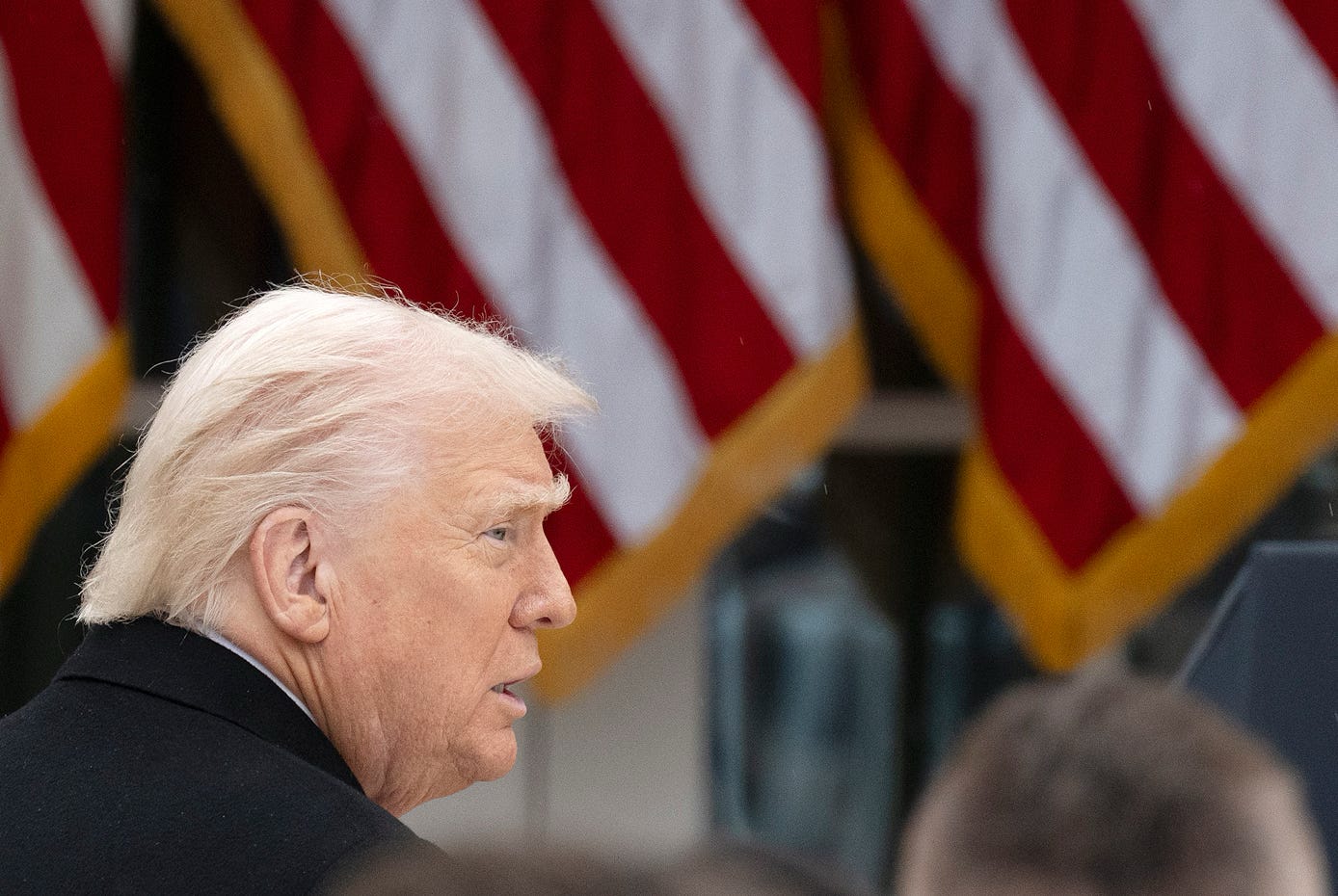
Photo: Marvin Joseph/The Washington Post
Overview
Date: December 5, 2025
Summary: The Trump administration has released a new National Security Strategy, marking a significant shift in U.S. foreign policy. The strategy prioritizes the Western Hemisphere, focusing on combating mass migration and drug trafficking, and reclassifies global terrorism within these hemispheric threats. It adopts a confrontational stance toward Europe, warning of “civilizational erasure” due to migration and advocating for support of nationalist parties, while simultaneously seeking to stabilize relations with Russia and question NATO expansion. This “America First” doctrine aims to redefine U.S. global engagement, moving away from traditional alliances and a global superpower role.
Sources
The New York Times - Trump Administration Says Europe Faces ‘Civilizational Erasure’
CNN - Army merges three commands in move to prioritize homeland defense
The Atlantic - The National Security Strategy Is Incoherent Babble
Key Points
All articles address the release of the Trump administration’s 33-page National Security Strategy (NSS) on December 5, 2025.
A central theme is the significant realignment of U.S. foreign policy, characterized by an “America First” doctrine.
The strategy marks a shift in focus from the Middle East and traditional global terrorism to prioritizing the Western Hemisphere.
It emphasizes homeland defense, combating mass migration, and drug trafficking as top national security concerns, including the potential use of lethal force.
The NSS introduces a “Trump Corollary” to the Monroe Doctrine, asserting U.S. preeminence in the Western Hemisphere to block foreign influence.
The strategy adopts a confrontational approach to Europe, warning of “civilizational erasure” due to migration and criticizing European governments’ policies.
It advocates for “cultivating resistance” within European nations by supporting nationalist and far-right political parties.
The document calls for an “expeditious cessation of hostilities” in Ukraine to stabilize European economies and reestablish “strategic stability” with Russia.
The strategy also expresses a desire to restrict the expansion of the NATO defense alliance.
Unique Highlights
The New York Times reports on Vice President JD Vance’s February speech in Munich, where he urged European leaders to end the isolation of far-right parties. It also details the European Union’s $140 million fine against X for breaching transparency rules and Vice President Vance’s criticism of the EU’s move.
CNN (Trump national security strategy…) highlights the administration’s “deadly campaign against alleged drug boats in international waters,” which has resulted in the destruction of 23 boats and the killing of 87 people, with legal experts questioning its legality. It also specifies the strategy’s dual-track approach to China, aiming to contain influence while preserving economic ties and maintaining Taiwan’s status quo, with a goal of boosting the U.S. economy from $30 trillion to $40 trillion.
CNN (Army merges three commands…) provides specific details about the creation of the new Army Western Hemisphere Command, formed by merging US Army Forces Command, US Army North, and US Army South, to be based at Fort Bragg, North Carolina. It includes quotes from Gen. Joseph Ryan and Col. Mike Burns and a timeline for the command to be fully operational by June 2026.
The Washington Post notes that the strategy implies a shift away from the U.S. global superpower role held since World War II, embracing an older form of might where militarily strong nations control their neighbors. It contrasts the new strategy’s vague approach to Russia with the Biden administration’s 2022 NSS, which prioritized “constraining Russia.”
Fox News quotes Alex Plitsas, a former Army intelligence officer, who questions the strategy’s emphasis on hemispheric threats, warning that “we have attempted to hide behind our oceans before. It has yet to work as a strategy.” It also cites Emily Harding, a senior fellow at CSIS, comparing the Middle East to a line from “The Godfather Part III” regarding its tendency to pull the U.S. back in. The article also mentions recent terror-related arrests, including an Afghan national shooting National Guard members in Washington, D.C.
The Atlantic describes the NSS as “incoherent babble,” “bombast, sycophancy, lies, inconsistencies, and grotesque self-contradictions.” It criticizes the document’s literary style and lack of intellectual coherence, suggesting it reflects the “muddled enthusiasms, resentments, insecurities, and vanities of the president himself.” However, it does identify three “valuable points” in the document: the U.S. tendency to ignore the Western Hemisphere until a crisis, shifting Africa’s focus from aid to commerce, and the challenge of mass migration in Europe.
Contrasting Details
Assessment of Terrorism as a Threat: While the strategy, as reported across all sources, downplays Islamic terrorism as a standalone pillar, Fox News presents arguments from experts like Alex Plitsas and Emily Harding who warn that the terrorist threat to the U.S. homeland remains significant and the Middle East can still pull the U.S. into conflicts, citing recent terror-related arrests as evidence.
Coherence and Quality of the Strategy Document: The New York Times, CNN, and The Washington Post report on the strategy’s content and implications as a formal policy document. In stark contrast, The Atlantic critiques the document itself, labeling it “incoherent babble,” an “embarrassing mess,” and full of “bombast, sycophancy, lies, inconsistencies, and grotesque self-contradictions,” questioning its intellectual rigor.
European Reactions and Interpretations: The strategy, as outlined by The New York Times, CNN, and The Washington Post, asserts that European governments ignore their populations’ desire for peace in Ukraine and subvert democratic processes. However, European officials quoted by The New York Times (Johann Wadephul, Brando Benifei) and The Washington Post (Paula Pinho) strongly reject these claims, with Benifei calling it a “frontal attack on the European Union” and Pinho disagreeing with suggestions that the EU undermines liberty or free speech.
The Newsie Project uses AI to summarize, compare, and contrast the reporting of the major US and world online news sources.
This is an evolving project. Tools, approaches, and output formats will change over time. The Newsie Project does not attempt to provide a definitive capsule of any news story. While the incidence of errors in these summaries is low, and I attempt to spot-check details, AI tools can hallucinate. Please click through and read the articles for details (some may be paywalled).