

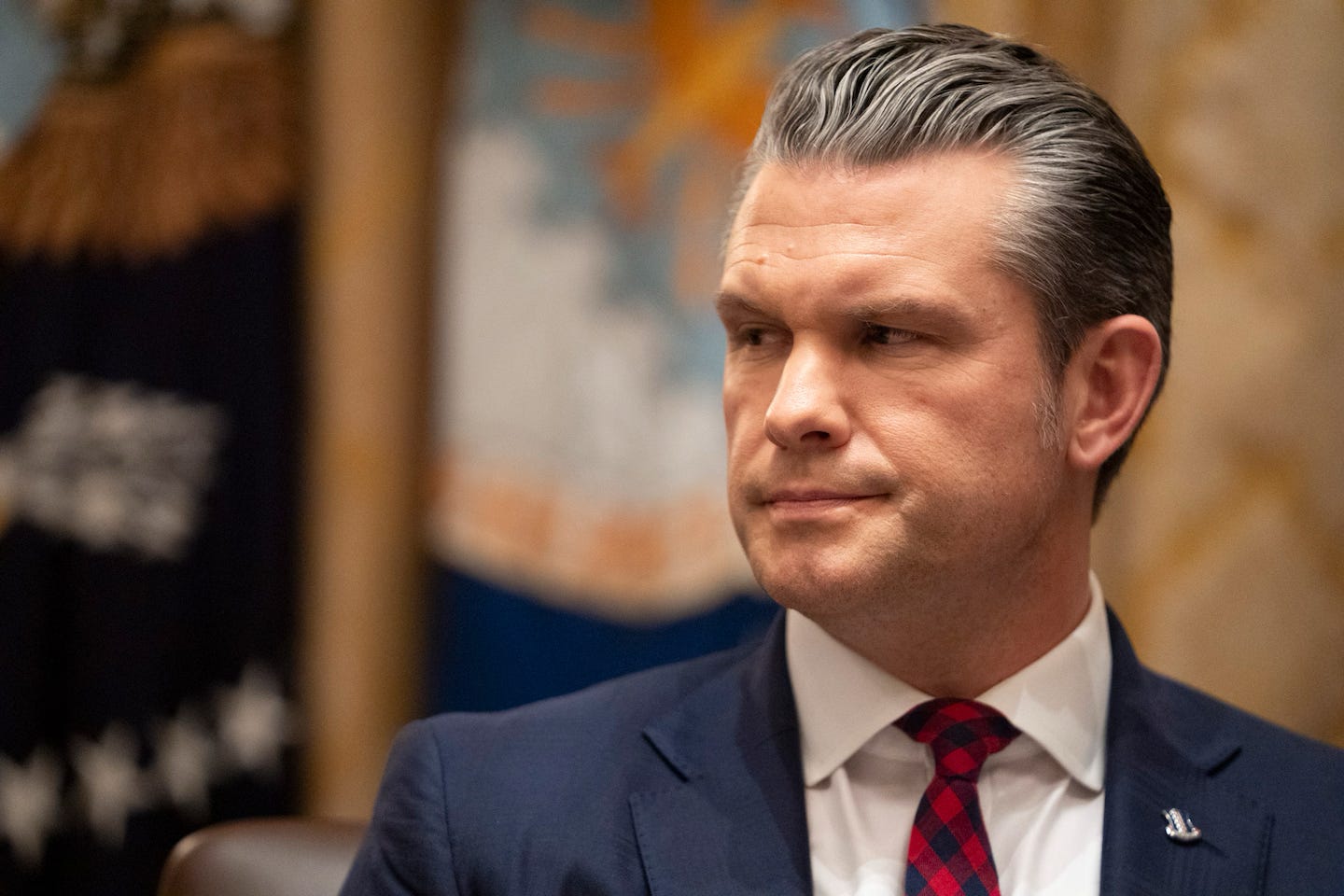
Photo: Carolyn Van Houten/The Washington Post
Overview
Date: December 3, 2025
Summary: A Pentagon Inspector General report concluded that Defense Secretary Pete Hegseth violated Defense Department regulations by using the encrypted messaging app Signal to share sensitive, classified information about planned military strikes against Houthi rebels in Yemen. The report found that Hegseth’s actions risked endangering American troops and mission objectives, though it did not definitively rule on whether he properly declassified the information, which he claims he did under his authority.
Sources
NBC News - Pentagon’s Signalgate review finds Pete Hegseth violated military regulations
The Washington Post - Watchdog finds Hegseth violated Pentagon protocol in ‘Signalgate’ affair
The Washington Post - Republicans begin to tighten the screws on Hegseth’s Pentagon
Key Points
The Defense Department Inspector General report concluded that Secretary Pete Hegseth violated military regulations by using Signal, an unclassified messaging app, to share sensitive operational details about planned military strikes against Houthi rebels in Yemen.
The information shared on Signal was deemed classified (marked “SECRET/NOFORN”) and its disclosure was found to have created risks to operational security, potentially endangering American troops and mission objectives.
Secretary Hegseth declined to be interviewed by Inspector General investigators, instead providing a written statement asserting that he had the authority to declassify information and made an operational decision to do so.
The Inspector General report did not explicitly determine whether Hegseth took the proper steps to declassify the information before sharing it.
The Signal group chat became public knowledge after Jeffrey Goldberg, editor-in-chief of The Atlantic, was inadvertently added to the discussion by then-National Security Advisor Mike Waltz.
Beyond the Signal issue, Secretary Hegseth is facing significant scrutiny and bipartisan inquiries regarding his involvement in a separate military operation on September 2, which led to the death of 11 people on an alleged drug smuggling boat, including two survivors of an initial strike.
Lawmakers from both Republican and Democratic parties are expressing concerns about Hegseth’s judgment and leadership, with some questioning whether the boat strike constituted a war crime.
Unique Highlights
CNN reported that messages from Hegseth’s Signal account were so specific that one read: “This is DEFINITELY when the first bombs will drop.” It also detailed that Hegseth shared similar details via Signal with several other unauthorized individuals, including a separate group chat with his wife, brother, and personal lawyer, and that he used staff to hardwire the app to access it from his secure Pentagon office.
NBC News specified that General Michael Erik Kurilla, who led U.S. Central Command, used a secure U.S. government system to send detailed information about the operation, including when U.S. fighters would take off and hit targets, and much of that same information appeared on the Signal chat.
The Washington Post noted that Hegseth at one point texted members of the group chat that they were “currently clean on OPSEC,” or operational security, despite sharing sensitive details. It also reported that Hegseth made light of the affair at a Fox Nation event and that then-National Security Advisor Mike Waltz was eventually removed from his White House post and now serves as U.N. ambassador.
The Washington Post reported that Hegseth gave a spoken order to “kill the entire crew of the vessel” before the first missile strike on the alleged drug smuggling boat. When two survivors were detected, Admiral Frank M. Bradley directed another strike to comply with Hegseth’s order that no one be left alive.
The Wall Street Journal mentioned that the Inspector General evaluation concluded in September but was not sent to lawmakers until Tuesday, due in part to a government shutdown. It also quoted Senator Eric Schmitt (R., Mo.) dismissing the report as a “nothing burger.”
Fox News provided specific timestamps and details from Hegseth’s Signal messages, including the types of aircraft and missiles to be used (F-18, Navy fighter aircraft, MQ-9s, drones, Tomahawks cruise missiles) and precise timings for launches and strikes. It also quoted National Security Advisor Mike Waltz’s message confirming mission success: “The first target — their top missile guy — was positively ID’d walking into his girlfriend’s building. It’s now collapsed.”
The New York Times specified that the air campaign was called Operation Rough Rider, lasted about six weeks, and involved attacking more than 800 targets in Yemen with roughly $1.5 billion worth of munitions. It also clarified that the Inspector General’s inquiry was an “evaluation” (for noncriminal violations) rather than an “investigation” (for potential criminal acts) and noted that the acting Inspector General, Steven A. Stebbins, took over after President Trump fired his predecessor.
Contrasting Details
Interpretation of the Inspector General Report Findings:
Chief Pentagon Spokesman Sean Parnell, cited by CNN, NBC News, The Wall Street Journal, and Fox News, stated that the Inspector General review is a “TOTAL exoneration of Secretary Hegseth and proves what we knew all along - no classified information was shared. This matter is resolved, and the case is closed.”
This directly conflicts with the findings reported by all news sources (CNN, NBC News, The Washington Post, The Wall Street Journal, Fox News, The New York Times), which, citing sources familiar with the report or lawmakers who read it, concluded that Secretary Hegseth did violate Defense Department regulations and shared information that was classified (marked “SECRET/NOFORN”) and posed a risk to troops and missions.
Senator Eric Schmitt (R., Mo.), quoted by The Wall Street Journal, dismissed the report as a “nothing burger” and an attempt to undermine Secretary Hegseth.
Senator Markwayne Mullin (R-Oklahoma), quoted by The Washington Post, asserted that Secretary Hegseth was “well within his authority to do what he did” and that no Pentagon protocols were broken, which contrasts with the report’s findings as described by other lawmakers and sources.
Secretary Hegseth’s Order Regarding Boat Strike Survivors:
The Washington Post reported that Secretary Hegseth gave a spoken order to “kill the entire crew of the vessel before the first missile strike,” and that Admiral Frank M. Bradley subsequently directed a second strike to comply with Hegseth’s order that no one be left alive after two survivors were detected.
Conversely, Fox News stated that “U.S. officials who spoke with The New York Times said Hegseth did not order the second strike,” creating a direct contradiction regarding the origin of the order for the follow-up strike on survivors.
Secretary Hegseth, as reported by The Washington Post and Fox News, claimed he did not issue such a directive for the second strike and did not witness it, stating Admiral Frank M. Bradley made the decision independently, though Hegseth stands by it. The Washington Post further quotes Hegseth saying he moved on to another meeting by the time Admiral Bradley decided to strike again, learning of the second attack “a couple of hours” later.
The Newsie Project uses AI to summarize, compare, and contrast the reporting of the major US and world online news sources.
This is an evolving project. Tools, approaches, and output formats will change over time. The Newsie Project does not attempt to provide a definitive capsule of any news story. While the incidence of errors in these summaries is low, and I attempt to spot-check details, AI tools can hallucinate. Please click through and read the articles for details (some may be paywalled).