

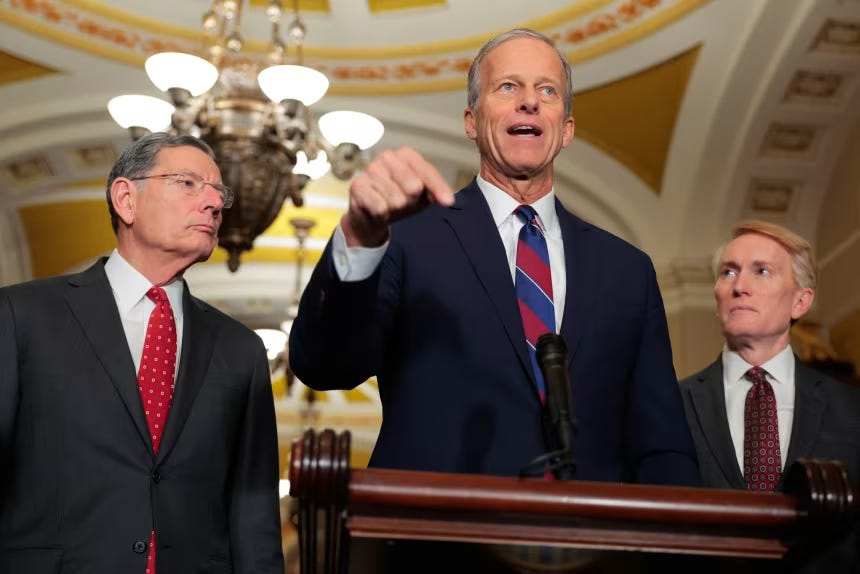
Photo: Heather Diehl/Getty Images
Overview
Date: December 9, 2025
Summary: Congress faces an imminent deadline as enhanced Affordable Care Act (ACA) tax credits are set to expire at the end of the year, threatening significant premium increases for millions of Americans. Democrats are pushing for a three-year extension of these subsidies, while Senate Republicans have coalesced around an alternative plan (the Crapo-Cassidy bill) that would allow the subsidies to expire and instead provide direct payments into health savings accounts.
Sources
The New York Times - G.O.P. Will Counter Democrats’ Bid to Preserve Subsidies With Their Own Plan
CNN - Senate to vote on GOP health care bill that does not extend expiring Obamacare tax credits
The Washington Post - Why Congress might not act on health care subsidies
The Wall Street Journal - No Rescue for ACA Subsidies in GOP Senators’ Healthcare Plan
Key Points
Enhanced Affordable Care Act (ACA) tax credits are set to expire at the end of the year, threatening increased premiums for millions of Americans.
Senate Democrats are proposing a three-year extension of these enhanced ACA subsidies to prevent premium hikes.
Senate Republicans have put forth an alternative proposal, the Crapo-Cassidy bill, which allows the enhanced subsidies to expire. Instead, it would provide direct payments into tax-advantaged health savings accounts (HSAs) for individuals purchasing high-deductible, low-premium plans.
Both the Democratic and Republican proposals are scheduled for a vote on Thursday, but are expected to fail in the Senate due to the requirement of 60 votes for advancement and a lack of bipartisan consensus.
Republicans are under political pressure to offer an alternative plan to show their commitment to addressing healthcare costs and to avoid blame for rising premiums in the upcoming midterm elections.
The Republican Crapo-Cassidy bill includes provisions that prohibit the use of funds for abortion services or gender transition procedures.
Democrats, including Senate Minority Leader Chuck Schumer, have dismissed the Republican plan as a “non-starter” or “junk insurance,” arguing it would not lower costs or extend the ACA tax credits.
President Donald Trump expressed support for the concept of money going directly to patients rather than insurance companies.
Unique Highlights
The New York Times mentions that Republican leaders had considered another plan for a two-year extension of subsidies with financial constraints, but ultimately did not select it as the party’s preferred alternative.
CNN quotes Senator Lisa Murkowski expressing skepticism that the GOP bill would secure the necessary 60 votes, noting that it “doesn’t deal with premiums.”
NBC News includes insights from health care policy experts: Sabrina Corlette of Georgetown described the Republican bill as “offering people a 1-foot rope to get out of a 10-foot hole,” and Larry Levitt of KFF highlighted that the plan would benefit healthier individuals while potentially increasing costs for sicker people. The article also specifies the direct payment amounts: $1,000 for people aged 18-49 and $1,500 for those 50-64. It cites Senators Josh Hawley and Thom Tillis warning that Republicans will be blamed if premiums double.
The Washington Post provides an analysis of three key reasons why Congress might not act on health care subsidies: the perception that extending subsidies would be an endorsement of Obamacare, the lack of consensus among Republicans on an alternative, and the unclear direction from President Trump on his preferred approach.
The Wall Street Journal reports the estimated cost of a three-year extension of ACA subsidies as roughly $90 billion, based on a Congressional Budget Office analysis. It also states that the Cassidy-Crapo bill would allocate $20 billion over two years specifically for cost-sharing reductions. The article references Senator Jon Husted’s alternative legislation proposing a two-year extension with specific conditions.
Fox News details Senator Roger Marshall’s “Marshall Plan,” which proposes a one-year extension of enhanced subsidies followed by a transition to HSAs, requiring a minimum $5 monthly premium payment, a government-issued ID to prevent fraud, and a gradual wind-down of enhanced credits until 2032. Senator Marshall also claims that Senate Minority Leader Chuck Schumer is acting as a “major roadblock” and “doesn’t want us to fix Obamacare.”
Contrasting Details
While The New York Times, CNN, NBC News, and The Wall Street Journal focus on the Crapo-Cassidy bill as the primary Republican alternative, The New York Times notes that a second Republican plan (a two-year extension with financial constraints) was considered but not chosen as the party’s preferred option.
Fox News presents Senator Roger Marshall’s “Marshall Plan” as a distinct Republican proposal, which aims to bridge the gap between Democratic and Republican demands by initially extending subsidies for one year before transitioning to HSAs, a different approach than the Crapo-Cassidy bill.
NBC News and The Wall Street Journal mention various other Republican proposals for short-term ACA extensions with specific conditions, further illustrating a lack of complete unity within the Republican party on a singular alternative, a point that The Washington Post analyzes as a reason for potential inaction.
Regarding Democratic opposition, CNN, NBC News, and The Wall Street Journal quote Senate Minority Leader Chuck Schumer criticizing the GOP plan as a “nonstarter” and “junk insurance” for not lowering costs. Fox News adds Senator Roger Marshall’s perspective that Schumer is intentionally obstructing a bipartisan solution for political reasons, suggesting a differing interpretation of Democratic motives.
The Newsie Project uses AI to summarize, compare, and contrast the reporting of the major US and world online news sources.
This is an evolving project. Tools, approaches, and output formats will change over time. The Newsie Project does not attempt to provide a definitive capsule of any news story. While the incidence of errors in these summaries is low, and I attempt to spot-check details, AI tools can hallucinate. Please click through and read the articles for details (some may be paywalled).