

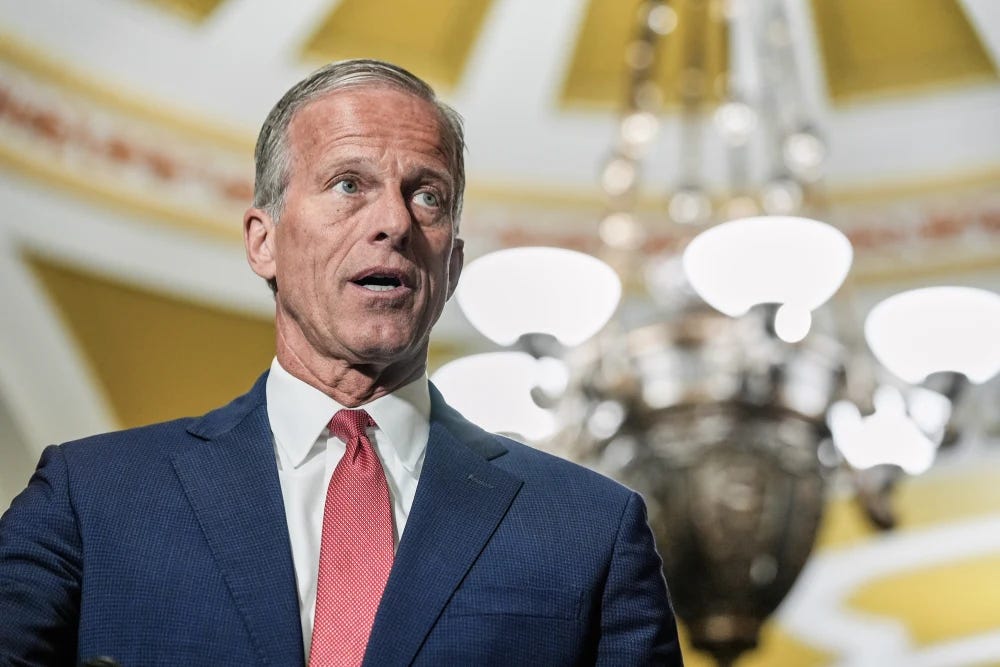
Photo: Mariam Zuhaib / AP
Overview
Date: September 11, 2025
Summary: Senate Republicans, frustrated by what they described as Democratic obstruction, triggered the “nuclear option” on September 11, 2025, to change Senate rules. This move, which passed with a simple majority vote after bipartisan negotiations collapsed, allows for the en bloc confirmation of executive branch civilian nominees, such as sub-Cabinet officials and ambassadors. The change aims to clear a significant backlog of President Donald Trump’s picks but specifically excludes Cabinet members, judicial nominees, and Supreme Court justices. Democrats condemned the action, arguing it would reduce scrutiny of nominees and predicting future regret for Republicans.
Sources
NBC News - Senate Republicans trigger ‘nuclear option,’ changing rules to speed up Trump nominees
The Washington Post - Republicans invoke ‘nuclear option’ in push to change Senate rules
The Wall Street Journal - Senate Republicans Go ‘Nuclear’ to Fast-Track Nominations
Fox News - GOP triggers nuclear option in Senate to break Dem blockade of Trump nominees
Key Points
Senate Republicans invoked the “nuclear option” to change Senate rules, allowing for the confirmation of multiple executive branch nominees simultaneously, or en bloc, rather than individually.
The rule change was passed by a majority vote, overriding the typical 60-vote threshold for such changes.
This change applies specifically to executive branch civilian nominees, including sub-Cabinet positions and ambassadors, but explicitly excludes Cabinet members, Supreme Court justices, and federal judges.
Republicans justified the move by citing a perceived pattern of Democratic obstruction and slow-walking of President Trump’s nominees, which had created a significant backlog.
Bipartisan negotiations to find an alternative solution and avoid the “nuclear option” ultimately collapsed shortly before the vote.
Democrats expressed strong disapproval, arguing that the rule change would diminish scrutiny of nominees and enable the confirmation of potentially unqualified individuals.
The “nuclear option” has been utilized by both Democratic and Republican majorities in the past to alter confirmation rules and debate times for various types of nominees.
Unique Highlights
CNN uniquely details that negotiations centered around a plan originally proposed by Senator Amy Klobuchar (D-MN) to confirm 10 nominees at once, with Republicans signaling a willingness to accept 15 from each committee. Senator Brian Schatz (D-HI) is quoted expressing “legitimate shock” at the collapse of negotiations, stating they were “94% of the way there.”
NBC News specifically identifies several nominees slated for fast-track confirmation, including former Representative Brandon Williams (R-NY) for undersecretary for nuclear security, Kimberly Guilfoyle as ambassador to Greece, and Callista Gingrich as ambassador to Switzerland. It also notes that Senator Katie Britt (R-AL) gave a presentation on the rules change proposal to House Republicans.
The Washington Post highlights a previous, separate negotiation attempt by Democrats to confirm more nominees in exchange for the Trump administration releasing frozen funding, which President Trump reportedly “torpedoed,” telling Senator Charles E. Schumer (D-NY) on social media to “GO TO HELL!” The article also notes the backlog was “nearly 150 nominees.”
The Wall Street Journal provides the specific Senate majority as 53-47. It quotes Senator John Thune (R-S.D.) stating that every president before Trump had a majority of their nominees confirmed by voice vote or unanimous consent, and that the Senate would need to cast another 600 votes to work through the current backlog.
Fox News states that this is the “fourth time in the Senate’s history” that the nuclear option has been used for this purpose. It also points out that through the first nine months of Trump’s presidency, not a single nominee had moved through fast-track unanimous consent or voice votes, and that the GOP’s rule change was “born from a revived Democratic proposal from 2023.”
Contrasting Details
Specifics of the Proposed Bipartisan Deal:
CNN and The Washington Post describe negotiations around a plan by Senator Amy Klobuchar (D-MN) to confirm 10 nominees at a time, with Republicans open to 15 from each committee.
Fox News mentions that lawmakers were close to a bipartisan deal that would have allowed for 15 nominees to be voted on in groups with two hours of debate. This is largely consistent, but Fox News specifies “two hours of debate” as part of that deal, which is not explicitly mentioned by CNN or The Washington Post in relation to the Klobuchar proposal.
The Newsie Project uses AI to summarize, compare, and contrast the reporting of the major US and world online news sources.
This is an evolving project. Tools, approaches, and output formats will change over time. The Newsie Project does not attempt to provide a definitive capsule of any news story. While the incidence of errors in these summaries is low, and I attempt to spot-check details, AI tools can hallucinate. Please click through and read the articles for details (some may be paywalled).