

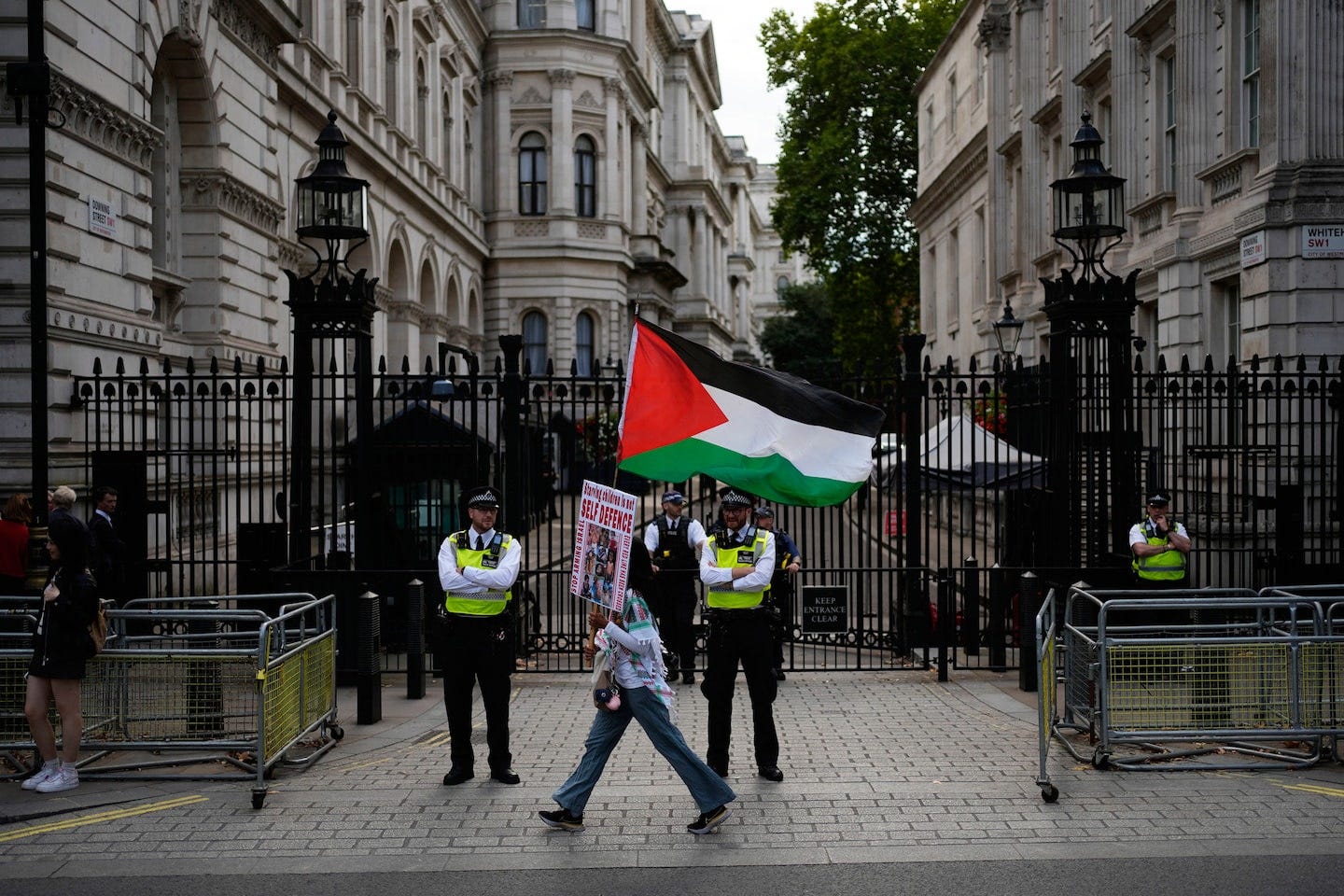
Photo: Jordan Pettitt/PA/AP
Overview
Date: September 21, 2025
Summary: On September 21, 2025, the United Kingdom, Canada, Australia, and Portugal formally recognized a Palestinian state. This coordinated diplomatic action marks a significant foreign policy shift for these traditional U.S. allies, reflecting growing international dissatisfaction with Israel’s military campaign in Gaza and its expansion of West Bank settlements. The recognizing countries cited a desire to revive hope for a two-state solution and address the severe humanitarian crisis in Gaza. Israeli Prime Minister Benjamin Netanyahu vehemently condemned the move, calling it a “reward for terrorism” after the October 7, 2023, attacks and vowing that a Palestinian state would not be established.
Sources
The New York Times - Britain, Australia, Canada and Portugal Recognize a Palestinian State
CNN - With US backing, defiant Netanyahu vows response to countries recognizing Palestinian state
NBC News - U.K., Canada and Australia formally recognize a Palestinian state, breaking with the U.S.
Fox News - UK, Canada, Australia recognize Palestinian state; Netanyahu vows ‘it will not happen’
The Washington Post - U.K., Canada, Australia recognize Palestine as a state, breaking with U.S.
Key Points
The United Kingdom, Canada, Australia, and Portugal formally recognized a Palestinian state on Sunday, September 21, 2025, with France and other European nations expected to follow suit at the United Nations General Assembly this week.
The primary motivation for these countries is to revive the prospect of a two-state solution and address the worsening humanitarian crisis in Gaza.
Israeli Prime Minister Benjamin Netanyahu strongly condemned the recognitions, calling them an “absurd reward for terrorism” and vowing that a Palestinian state would not be established west of the Jordan River. He indicated Israel would announce its response after meeting with U.S. President Donald Trump next week.
The United States, led by President Trump, opposes the recognition, maintaining that a Palestinian state should emerge from direct negotiations between the parties.
The recognizing countries, particularly the United Kingdom, explicitly stated that their decision is not a reward for Hamas and that Hamas should have no role in a future Palestinian government. Hamas, however, welcomed the recognition as a rightful outcome of the Palestinian struggle.
The recognition is largely symbolic, granting Palestinians increased diplomatic standing and potential for treaty-making, but it is not expected to immediately alter the realities on the ground in Gaza or the occupied West Bank.
This diplomatic shift occurs against the backdrop of the ongoing war in Gaza, the October 7, 2023, attacks, and Israel’s continued expansion of Jewish settlements in the West Bank.
These countries join over 140 other United Nations member states that already recognize a Palestinian state.
Unique Highlights
The New York Times details British Prime Minister Keir Starmer’s initial conditions for recognition (addressing humanitarian crisis, cease-fire, two-state solution) and notes that these conditions were not met. It also highlights Britain’s sanctions on two far-right Israeli ministers, Itamar Ben-Gvir and Bezalel Smotrich, and the potential for an arrest warrant for Prime Minister Netanyahu if he entered Britain. The article quotes Daniel Levy, who suggests the recognition will likely not change the situation without further consequential measures.
CNN reports that Israeli Prime Minister Netanyahu is operating with the “backing of the United States” and feels he can “do just about anything, under a blanket of US diplomatic protection.” It details explicit calls from Netanyahu’s far-right allies, such as Finance Minister Bezalel Smotrich and Minister of National Security Itamar Ben Gvir, for the annexation of the entire West Bank and the dismantling of the Palestinian Authority. It also notes that U.S. Secretary of State Marco Rubio had unsuccessfully tried to convince countries not to recognize Palestine.
NBC News states that Canada was the “first Group of 7 nation to recognize the state of Palestine.” It provides specific casualty figures, noting that “More than 65,000 people have been killed in Gaza since October 2023, including thousands of children,” according to the local Palestinian Health Ministry. It also mentions that the Hostage and Missing Families Forum condemned the decision. The article highlights French President Emmanuel Macron’s statement on Israeli television, where he denounced Israel’s new ground offensive in Gaza City as “absolutely unacceptable” and “a huge mistake.”
Fox News specifies that “Forty-eight hostages remain in Gaza, with fewer than half believed to still be alive.”
The Washington Post emphasizes Britain’s “special resonance” given its controversial history governing the region under a League of Nations mandate, including “unclear and contradictory promises to Arabs and Jews.” It notes that Starmer faced significant domestic pressure from the British public and his Labour Party, with “more than one-third of Starmer’s cabinet” and “more than 130 members of Parliament” supporting the move. Diana Buttu, a Palestinian human rights lawyer, states that the recognition clarifies the conflict as “one state occupying another state” and highlights Britain’s historic responsibility due to the Balfour Declaration.
The Wall Street Journal describes the recognition as a “diplomatic and political defeat for Israel,” according to Yuval Shany, a law professor. It points out that this move marks the fracturing of a united Western strategy where recognition was previously a “carrot” for Palestinians, now becoming a “stick” against Israel. The article mentions that Israel already holds “at least 75% of the Gaza Strip” and discusses how annexation of parts of the West Bank could risk Israel’s normalization deals with Arab countries (Abraham Accords). It also states that the U.K. government will set out “further economic sanctions targeting Hamas.”
Contrasting Details
Casualty Reporting Nuance: NBC News states “More than 65,000 people have been killed in Gaza,” while The Washington Post and The Wall Street Journal add the important detail that Gaza health officials reporting these figures “do not differentiate between civilian and combatant casualties but say the majority of the dead are women and children” (The Washington Post) or “don’t say how many were combatants” (The Wall Street Journal).
The Newsie Project uses AI to summarize, compare, and contrast the reporting of the major US and world online news sources.
This is an evolving project. Tools, approaches, and output formats will change over time. The Newsie Project does not attempt to provide a definitive capsule of any news story. While the incidence of errors in these summaries is low, and I attempt to spot-check details, AI tools can hallucinate. Please click through and read the articles for details (some may be paywalled).