

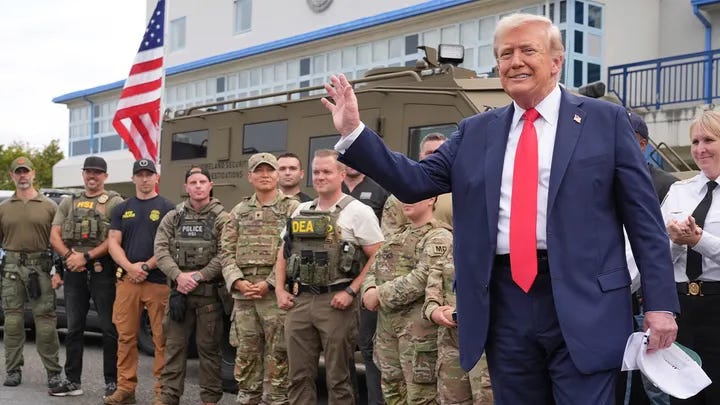
Photo: Jacquelyn Martin/AP
Overview
Date: August 31, 2025 - September 1, 2025
Summary: The Trump administration is aggressively deploying federal law enforcement and National Guard troops into U.S. cities, ostensibly to combat crime and enforce immigration laws. This strategy, exemplified by a crime crackdown in Washington D.C., involves significant gun confiscations and arrests. However, it faces strong opposition from Democratic governors and mayors, particularly in Chicago, who denounce it as an unconstitutional “invasion” and politically motivated overreach.
Sources
The New York Times - Crime Festers in Republican States While Their Troops Patrol Washington
The Washington Post - Chicago launches resistance campaign as Trump threatens to send troops
Key Points
The Trump administration is implementing a strategy of federal intervention in U.S. cities, involving the deployment of federal law enforcement and National Guard troops, for both crime crackdowns and immigration enforcement.
These interventions are widely perceived as politically motivated, primarily targeting Democratic-led “blue” cities, despite critics pointing out that many Republican-led states also grapple with high crime rates.
A significant element of the D.C. crime crackdown is an aggressive focus on gun confiscation and increased federal firearms prosecutions, marking a departure from the administration’s historical stance on gun rights.
Democratic leaders in cities and states facing potential federal deployment, such as Chicago and Illinois, are vocally resisting these actions, characterizing them as an “invasion” and an “unconstitutional military occupation.”
The federal government is covering the substantial costs of these National Guard deployments, estimated at $1 million per day in D.C., while Democratic governors accuse the Trump administration of simultaneously cutting federal funding for local law enforcement.
Concerns persist regarding the long-term effectiveness of these federal surges in reducing crime and the legality of the tactics employed by federal agents, with reports of grand juries refusing to indict some individuals.
Unique Highlights
The New York Times specifies that approximately 150 weapons have been confiscated and 105 arrests made in D.C. since the crime emergency declaration. It details Attorney General Pam Bondi’s near-daily social media tallies of gun seizures. Also, it highlights U.S. Attorney Jeanine Pirro’s past support for assault rifle restrictions, contrasting with her office’s recent policy shift (at the White House’s urging) to no longer seek felony charges for long guns.
The New York Times lists multiple Republican-led cities—including Memphis, Nashville, Kansas City, St. Louis, Birmingham, and Houston—that have violent crime rates comparable to or higher than Washington D.C. It quotes experts like Adam Gelb and Jeffrey A. Butts, who assert that federal interventions are not based on crime statistics but are designed to “humiliate political opponents.” It also specifies the daily cost of the D.C. National Guard deployment at $1 million for over 2,000 troops from six states.
CNN clarifies that the anticipated Chicago operation is primarily focused on immigration enforcement, involving Immigration and Customs Enforcement (ICE) and Customs and Border Protection (CBP) with potential Guard support for “peacekeeping.” It includes Homeland Security Secretary Kristi Noem’s statement that the administration is considering expanding operations to San Francisco, Boston, and even Republican-led cities. It details Chicago Mayor Brandon Johnson’s executive order urging federal agents to use body cameras and refrain from wearing masks.
The Washington Post reveals that the Pentagon has been planning a military deployment in Chicago for weeks, with ICE requesting to use a Navy base north of the city as a launchpad for immigration crackdowns. It notes that Chicago Mayor Johnson’s executive order includes a program to educate residents on how to prepare if detained by federal agents. The article also mentions Trump’s previous deployment of the National Guard to Los Angeles in June for immigration enforcement and quotes Secretary Noem stating, “L.A. wouldn’t be standing today if President Trump hadn’t taken action.” It also highlights instances of grand juries in Washington and L.A. refusing to indict individuals for alleged crimes.
Contrasting Details
Crime Rate Justifications: The New York Times directly contradicts President Trump’s assertion that there are “not that many” high-crime cities in Republican-led states, providing numerous examples like Memphis and Nashville with higher or comparable crime rates to D.C.
Chicago Crime Statistics: CNN and The Washington Post present conflicting views on Chicago’s crime trends. CNN reports Trump’s social media post about 6 killed and 24 shot over one weekend, and the Chicago Police Department reporting 52 shot and 7 fatally over a holiday weekend. In contrast, both CNN and The Washington Post cite the Chicago mayor’s office touting significant decreases in crime, including a 21.6% decrease in overall violent crime and a 32.3% decrease in homicides year-to-date.
Local Leadership Response to Federal Presence: The New York Times and The Washington Post show a clear divergence in how local leaders are handling federal intervention. D.C. Mayor Muriel Bowser has adopted a “more conciliatory approach,” crediting the deployment for “more accountability” and reduced carjackings. Conversely, Chicago Mayor Brandon Johnson and Illinois Governor JB Pritzker are actively resisting, calling it an “invasion” and signing executive orders against cooperation.
U.S. Attorney Jeanine Pirro’s Gun Stance: The New York Times details a shift in U.S. Attorney Jeanine Pirro’s position on guns. She previously supported restrictions on assault rifles, but her office recently announced it would no longer seek felony charges for possession of rifles or shotguns, a policy change reportedly urged by White House officials and applauded by gun rights groups.
The Newsie Project uses AI to summarize, compare, and contrast the reporting of the major US and world online news sources.
This is an evolving project. Tools, approaches, and output formats will change over time. The Newsie Project does not attempt to provide a definitive capsule of any news story. While the incidence of errors in these summaries is low, and I attempt to spot-check details, AI tools can hallucinate. Please click through and read the articles for details (some may be paywalled).