

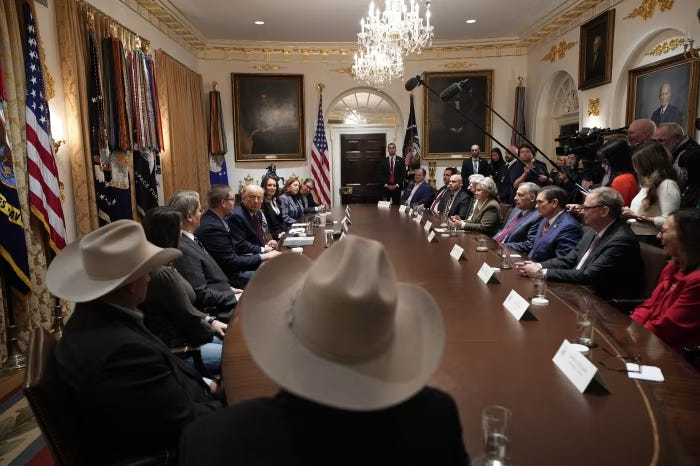
Photo: Yuri Gripas/Press Pool
Overview
Date: December 8, 2025
Summary: President Donald Trump announced a $12 billion aid package for American farmers, primarily to mitigate the financial hardships caused by his administration’s trade war and tariffs, particularly affecting soybean exports to China. The package includes $11 billion in one-time payments through the Farmer Bridge Assistance program for crop farmers, with $1 billion reserved for specialty crops. The funds are expected to be distributed by late February 2026, following the announcement at a White House roundtable with farmers and key administration officials.
Sources
The New York Times - Trump Promises Farmers $12 Billion to Blunt Fallout From His Trade War
The Washington Post - Trump announces $11 billion tariff relief for farmers
The Wall Street Journal - Trump Unveils $12 Billion Bailout for Farmers
Fox News - Trump to unleash $12B farm rescue as China trade reset hits US growers
Key Points
President Trump announced a $12 billion aid package for American farmers.
The aid is designed to address financial difficulties faced by farmers, largely attributed to the impact of the administration’s trade policies and tariffs, particularly concerning China.
The package primarily consists of $11 billion in one-time payments through the Farmer Bridge Assistance program for crop farmers, with an additional $1 billion allocated for specialty crops.
The funds are expected to be disbursed by the end of February 2026.
The announcement was made at a White House roundtable attended by farmers, Agriculture Secretary Brooke Rollins, and Treasury Secretary Scott Bessent.
The decline in Chinese purchases of U.S. soybeans, which have recently begun to resume, is a central factor in the need for assistance.
President Trump stated that the aid money comes from tariff revenues.
Unique Highlights
CNN reported that Agriculture Secretary Brooke Rollins had previously hinted at bridge payments at a Cabinet meeting last week and suggested that Biden administration policies, rather than Trump’s tariffs, were the cause of farmers needing assistance. It also included a quote from Mark Read of the Illinois Soybean Association stating, “Farmers don’t want free aid. We want free trade.”
NBC News noted Trump’s promise to loosen environmental regulations for machinery companies and his demand that these companies lower their prices. It also detailed Treasury Secretary Scott Bessent’s statement that China’s purchases are in a “perfect cadence” and that China is “on track to keep every part of the deal,” with Trump believing Chinese President Xi Jinping will buy “even more.” The article also mentioned a $20 billion currency swap agreement with Argentina and that some farmers perceived this as bailing out competition.
The New York Times framed the package as an “acknowledgment by the administration that Mr. Trump’s trade policies have had negative consequences.” It specified the crops covered by the Farmer Bridge Assistance program (corn, cotton, sorghum, soybean, rice, cattle, and wheat) and pointed out additional burdens on farmers, such as high tariffs on farm equipment metal and immigration restrictions impacting labor. The article included an estimate from Shawn Arita, a senior research economist, that crop producers face $35 billion to $43 billion in losses this fall, suggesting the $12 billion may be insufficient. It also cited independent analyses from Trump’s first term showing aid disproportionately went to larger farms and some wheat farmers received excessive compensation.
The Washington Post highlighted that farmers are a “reliable base of support” for Trump, citing Investigate Midwest data that U.S. counties heavily reliant on farming supported Trump by over 77% in the 2024 election. The article reported that 181 farmers filed for bankruptcy in the first half of the year, a 60% increase and the highest six-month reading since 2020. It also detailed Trump’s $20 billion bailout to Argentina and subsequent promise to buy beef from Argentina, which raised objections from some of his base.
The Wall Street Journal included a graph of soybean futures and mentioned that the aid package had been discussed “behind the scenes for months.” It reported that farm bankruptcies rose by about 60% in the first half of 2025 compared to 2024. The article also noted that China’s usual imports of U.S. soybeans (29 million metric tons annually) dropped to zero until a recent deal, and that China has purchased only about 20% of what it agreed to buy this year, causing nervousness among farmers. It also stated that China has been preparing to squeeze American farmers out of its export market by investing heavily in Brazil’s agricultural supply chain.
Fox News quoted White House spokeswoman Anna Kelly on Trump “negotiating new trade deals to open new export markets” and “boosting the farm safety net.” It provided details about Trump agreeing to cut tariffs on Chinese imports by 10% (from 57% to 47%) in exchange for China’s cooperation on the U.S. fentanyl crisis during an October meeting in South Korea.
Contrasting Details
Source of Farmers’ Financial Hardship: While The New York Times, The Washington Post, The Wall Street Journal, and Fox News explicitly linked the need for aid to President Trump’s trade war and tariffs, CNN, quoting Agriculture Secretary Brooke Rollins, reported Rollins’ suggestion that Biden administration policies, not Trump’s tariffs, caused farmers to need assistance.
Amount of Aid in Headline: The Washington Post’s headline referred to an “$11 billion tariff relief for farmers,” whereas CNN, NBC News, The New York Times, The Wall Street Journal, and Fox News all cited a “$12 billion” aid package in their headlines. The Washington Post’s article body clarified that $1 billion was being held back from an anticipated $12 billion package.
China’s Fulfillment of Soybean Purchase Commitments: NBC News, quoting Treasury Secretary Scott Bessent, reported that China’s purchases are in a “perfect cadence” and that China is “on track to keep every part of the deal,” with Trump believing China will buy “even more.” In contrast, The New York Times stated that “China’s Ministry of Commerce has not confirmed the White House’s interpretation of the agreement, and already China is falling behind on its soybean purchases,” noting that China had bought only 2.7 million metric tons out of the agreed-upon 12 million. The Wall Street Journal also reported that China had purchased only about 20% of what it agreed to buy, leading to nervousness among farmers.
Sufficiency of Aid: The New York Times, citing economist Shawn Arita, suggested that the $12 billion “probably will not be enough to stanch their losses this year,” estimating losses between $35 billion and $43 billion. Conversely, The Washington Post, quoting American Soybean Association President Caleb Ragland, described the program as a “positive first step,” and The Wall Street Journal noted that farmers said the money would help them pay down debts and finance next year’s crop.
The Newsie Project uses AI to summarize, compare, and contrast the reporting of the major US and world online news sources.
This is an evolving project. Tools, approaches, and output formats will change over time. The Newsie Project does not attempt to provide a definitive capsule of any news story. While the incidence of errors in these summaries is low, and I attempt to spot-check details, AI tools can hallucinate. Please click through and read the articles for details (some may be paywalled).