

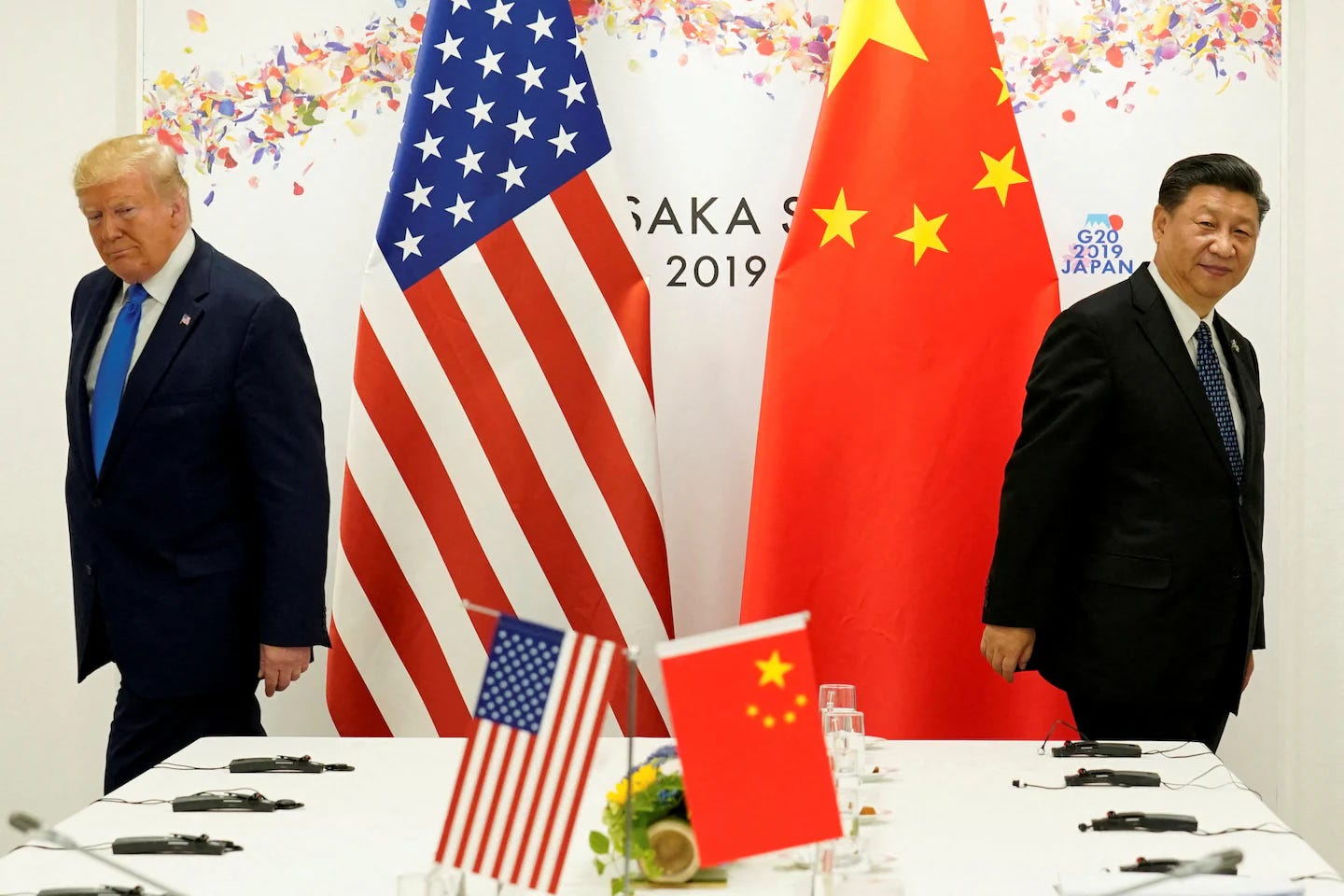
Photo: Kevin Lamarque/Reuters
Overview
Date: October 10, 2025
Summary: President Donald Trump announced a new 100% tariff on all Chinese goods, effective November 1, 2025, in retaliation for China’s sweeping new export controls on rare-earth minerals. This move significantly escalates the trade war between the two economic powers, following a period of seemingly cooling tensions. Trump also threatened export controls on critical software and cast doubt on a planned meeting with Chinese leader Xi Jinping. The announcements immediately triggered a sharp decline in global stock markets, reflecting widespread concerns about economic instability and disrupted supply chains.
Sources
The New York Times - In Retaliatory Move, Trump Threatens 100% Tariffs on Chinese Goods
The Washington Post - Trump announces new 100 percent tariffs on China
Fox Business - Trump announces 100% additional tariff on China beginning in November
Interesting related article on tariff impacts on international package delivery from NBC News:
UPS is ‘disposing of’ U.S.-bound packages over customs paperwork problems - Shifting Trump tariffs have created a nightmare for UPS, as thousands of packages from overseas pile up at its hubs while they await customs clearance.
Key Points
President Trump announced a 100% additional tariff on Chinese goods, set to take effect on November 1, 2025, “over and above” existing tariffs.
This action is a direct retaliation to China’s recent imposition of sweeping export controls on rare-earth minerals and related technologies.
Trump also stated that the U.S. would implement export controls on “any and all critical software.”
The President threatened to cancel or expressed doubt about a planned meeting with Chinese President Xi Jinping at the Asia-Pacific Economic Cooperation (APEC) summit in South Korea later in the month.
Rare-earth minerals are highlighted as vital components for a wide array of high-tech products, including semiconductors, electric vehicles, jet engines, and consumer electronics.
China’s dominance in the mining and processing of rare-earth minerals is emphasized as a significant source of leverage.
The announcements caused a sharp decline in U.S. stock markets, with the S&P 500, Dow Jones Industrial Average, and Nasdaq Composite all experiencing significant drops.
The escalation follows a period where trade talks between the U.S. and China had suggested a cooling of tensions, making this renewed conflict a surprise to many.
Unique Highlights
The New York Times notes that Mr. Trump has placed extreme tariffs on Chinese exports before, only to walk them back, and details China’s April response to tariffs by clamping down on mineral exports for U.S. automakers and defense manufacturers. It also highlights the global nature of China’s restrictions mirroring U.S. semiconductor controls, and mentions China’s antimonopoly investigation into Qualcomm and new fees for U.S. ships.
CNN reports Trump’s assertion that China’s move was “obviously a plan devised by them years ago” and “a moral disgrace.” It details the Trump administration’s efforts to accelerate domestic rare-earth production, including a $400 million equity stake in MP Materials Corp. It also mentions Trump slamming China for timing its announcement to overshadow his efforts to secure a Middle East peace deal.
NBC News states that current U.S. tariffs on Chinese goods are approximately 40% and references multiple rounds of trade talks earlier in the year (Geneva in May, London in June) where rare earth export controls were discussed and reportedly “resolved” or eased, according to the administration. It also mentions a “framework for a TikTok deal” that China has not yet confirmed.
The Washington Post provides that average tariffs on imports from China stand at about 57% according to the Peterson Institute for International Economics, after hitting a high of 140% earlier this year. It notes that Beijing also announced an antitrust probe into U.S. AI chip champion Nvidia, in addition to Qualcomm. The article also draws parallels to past high-level meetings between the two countries being derailed by geopolitical events.
The Wall Street Journal highlights that U.S. Treasury Secretary Scott Bessent and U.S. Trade Representative Jamieson Greer are “particularly incensed” by China’s actions. It points out a “critical window for negotiation” between Trump’s November 1 tariff date and Beijing’s December 1 control date. The article suggests that Beijing officials were surprised that their actions would jeopardize the summit and reports that Vice Premier He Lifeng believed an informal “freeze” on new export controls had been agreed upon, which was shattered by new U.S. controls on foreign-owned companies. It also specifies that under China’s new rules, global companies need permission if Chinese minerals account for 0.1% or more of a product’s value.
Fox Business quotes Mitchell Silk, former Assistant Secretary for International Markets at the U.S. Treasury, describing China’s trade tactics as “a lot of games, a lot of funny business.”
Contrasting Details
Current Average Tariff Levels:
NBC News states that “Currently, the U.S. has tariffs of about 40% on Chinese goods.”
The Washington Post reports that “Average tariffs on imports from China stand at about 57 percent, according to the Peterson Institute for International Economics, after hitting a high of 140 percent at the peak of Trump’s trade war earlier this year.”
Status of the Xi-Trump Meeting: While all articles report Trump threatening to cancel the meeting, some indicate a softening of his stance.
The New York Times notes Trump “suggested that the tariffs could be walked back… and that he would not necessarily cancel his planned meeting with Mr. Xi.”
CNN states that Trump initially indicated the meeting was in jeopardy but later, when asked, said: “I haven’t canceled, but I don’t know that we’re going to have it. But I’m going to be there regardless, so I would assume we might have it.”
The Wall Street Journal mentions, “Though Trump later suggested he would still be open to a meeting, the threat surprised some Beijing officials, who didn’t anticipate the action would place the summit at risk.”
Prior Agreements on Rare Earth Export Controls: There are differing accounts of previous understandings regarding rare earth exports.
NBC News states that after talks in May and June, the U.S. administration believed China had “decided to ease up on rare earth export controls” and that the issue was expected to be “resolved,” with Trump announcing “our deal with China is done” regarding rare earth supply.
The Wall Street Journal reports that “Vice Premier He Lifeng believed an informal “freeze” on new export controls had been agreed upon following recent talks in Madrid,” but this understanding “was shattered when the U.S. introduced new controls on foreign-owned companies,” with Chinese leader Xi Jinping himself deciding to retaliate.
The New York Times mentions a “fragile truce in meetings this spring that led to Mr. Trump’s reducing his tariffs and Beijing’s approving more mineral exports,” which was then escalated by Beijing.
China’s Motivation for Escalation: While generally seen as leverage, specific interpretations vary.
CNN reports Trump suggesting China timed its announcement to overshadow his Middle East peace deal efforts.
The Wall Street Journal explicitly states China’s move was “a calculated action to demonstrate Beijing’s leverage over the U.S. economy and force Trump to the negotiating table with a weaker hand.”
The Washington Post quotes analysts who suggest Xi’s moves were intended to keep Trump from pushing too hard in negotiations (Jake Werner) and that Trump felt Beijing “broke that tacit understanding” (Ryan Hass).
The Newsie Project uses AI to summarize, compare, and contrast the reporting of the major US and world online news sources.
This is an evolving project. Tools, approaches, and output formats will change over time. The Newsie Project does not attempt to provide a definitive capsule of any news story. While the incidence of errors in these summaries is low, and I attempt to spot-check details, AI tools can hallucinate. Please click through and read the articles for details (some may be paywalled).