

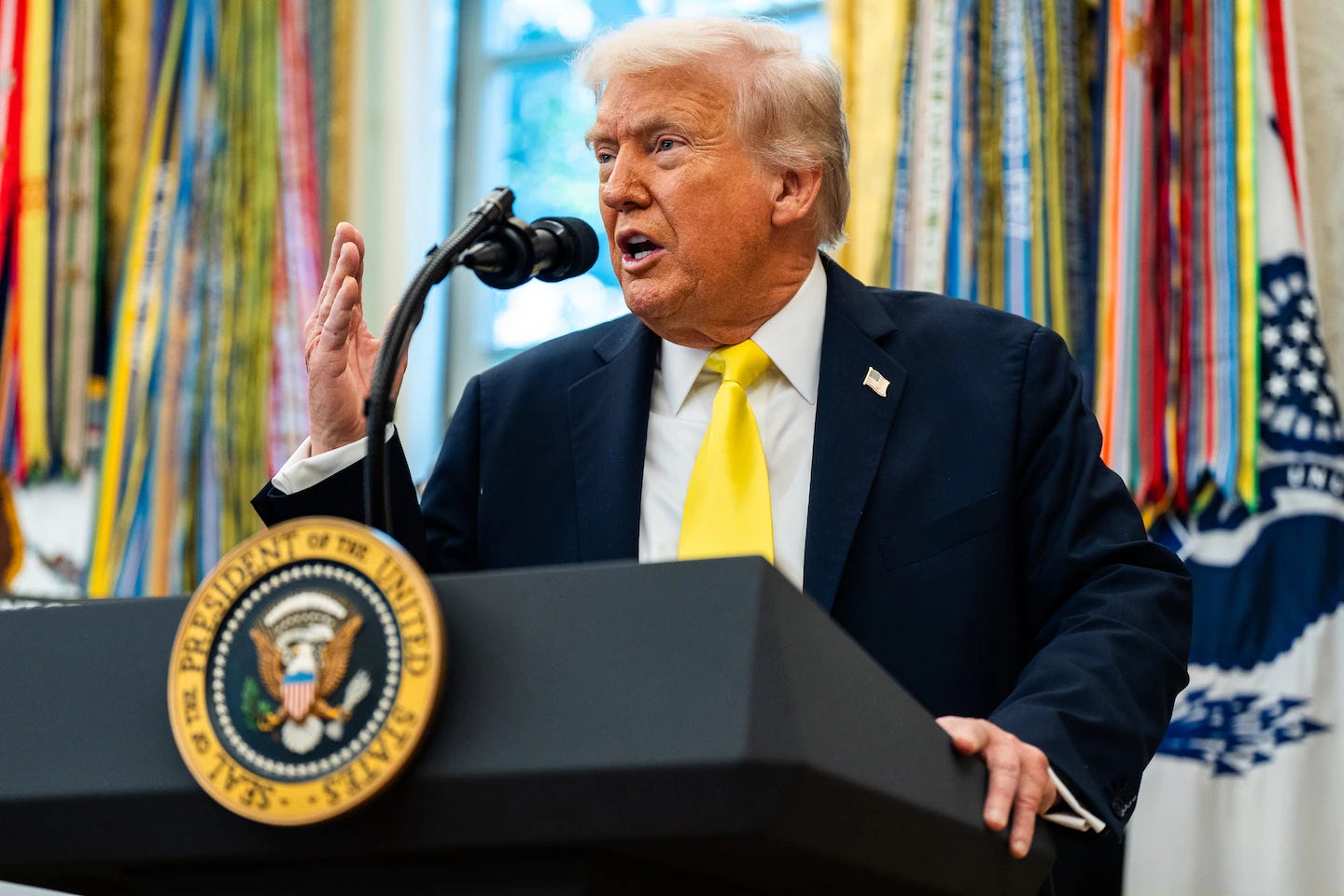
Photo: Demetrius Freeman/The Washington Post
Overview
Date: October 15, 2025
Summary:
President Donald Trump has publicly confirmed authorizing covert CIA operations in Venezuela, marking a significant escalation in the U.S. campaign against Nicolás Maduro’s government. This authorization, initially reported by The New York Times, allows the CIA to conduct a range of clandestine activities, potentially including lethal operations, either unilaterally or in conjunction with military actions. Trump cited Venezuela’s alleged emptying of prisons into the U.S. and significant drug trafficking as his reasons. The confirmation comes amidst an already intensified U.S. military presence in the Caribbean, where forces have conducted multiple lethal strikes on suspected drug-carrying boats, killing at least 27 people. Trump also indicated that land-based military strikes inside Venezuela are being considered, further raising tensions and concerns about the potential for regime change.
Sources
The New York Times - Trump Administration Authorizes Covert C.I.A. Action in Venezuela
NBC News - Trump confirms he authorized CIA action in Venezuela
The Washington Post - Trump says he has authorized covert CIA action in Venezuela
The Wall Street Journal - Trump Authorizes CIA Covert Operations in Venezuela
BBC - Trump confirms he authorised CIA action inside Venezuela
Key Points
President Trump publicly confirmed authorizing the CIA to conduct covert operations in Venezuela, an unusual acknowledgment for a U.S. commander-in-chief.
Trump cited two primary reasons for the authorization: Venezuela allegedly emptying its prisons into the United States and significant drug trafficking originating from Venezuela.
The authorization is part of an escalating U.S. pressure campaign against Nicolás Maduro, whom the U.S. considers an illegitimate leader.
Trump explicitly stated he is considering military strikes on land-based targets within Venezuela, having asserted that maritime drug routes are “under control.”
U.S. forces have already conducted multiple lethal strikes against suspected drug-carrying boats in the Caribbean, resulting in at least 27 deaths.
The authorization, a “presidential finding,” grants the CIA the ability to carry out a range of clandestine activities, potentially including lethal operations, either unilaterally or in conjunction with broader military actions.
There is a substantial U.S. military presence in the Caribbean, including warships, a submarine, fighter jets, and thousands of troops, which has raised fears in Caracas of a possible attack.
Nicolás Maduro’s government has responded by ordering military exercises and mobilizing forces to defend Venezuela, accusing the U.S. of plotting regime change and seeking to exploit the country’s natural resources.
Unique Highlights
The New York Times provides a detailed historical overview of the CIA’s mixed record of covert actions in Latin America and the Caribbean, citing specific examples like the 1954 Guatemala coup, the 1961 Bay of Pigs invasion, and involvement in Brazil, Chile, and Nicaragua.
The Washington Post details that the CIA has surged personnel to the Caribbean and Central America for intelligence collection, not armed operations, and that CIA surveillance drones are active over Mexico targeting fentanyl labs. It also notes concerns from former officials that unilateral action could damage CIA relationships in the region.
EL PAÍS reports that Trump ordered an end to diplomatic contacts with Venezuela after Maduro attempted to appease the U.S. with an offer to participate in the exploitation of the country’s natural resources, including oil and other raw materials.
BBC uniquely mentions that UN-appointed human rights experts have described the U.S. raids on suspected drug-carrying boats as “extrajudicial executions.”
The Wall Street Journal quotes CIA Deputy Director Michael Ellis stating that the CIA is applying counterterrorism tactics to what has traditionally been a law-enforcement issue, aiming to “dismantle a network.”
The Washington Post highlights that top Democrats on national security committees in Congress issued a joint statement expressing concern that Trump “failed to state a clear military objective” and provided no explanation for how the military action would end.
Contrasting Details
Venezuela’s Role in Drug Trade: While President Trump asserts that “a lot of drugs” are coming from Venezuela, The Washington Post and BBC state that Venezuela is not considered a major source of fentanyl or other synthetic opioids for the U.S., and cocaine trafficked through the Caribbean is mostly not bound for North American markets.
Nature of Drug Smuggling Routes: President Trump implied that fentanyl is found “all over the ocean” after boat strikes, suggesting maritime fentanyl trafficking. However, NBC News and The Washington Post cite experts who say fentanyl is mainly smuggled over land routes in small, easily concealed amounts across the Mexico-U.S. border, not primarily by boat through the Caribbean.
CIA’s Direct Involvement in Lethal Strikes: The New York Times states the new authority would allow the CIA to carry out lethal operations. However, The Washington Post clarifies that the CIA is not playing a direct role in the lethal strikes against drug trafficking boats; these are conducted by Defense Department Special Operations units using military intelligence, with CIA personnel only part of a tracking group but not involved in target decisions.
Maduro’s Control of “Tren de Aragua”: The New York Times reports that while the Trump administration has asserted in legal filings that Mr. Maduro controls a criminal gang, Tren de Aragua, an assessment by U.S. intelligence agencies contradicts that conclusion.
Goal of U.S. Actions (Regime Change vs. Counter-narcotics): While multiple articles (e.g., The New York Times, EL PAÍS) indicate the U.S. ultimate goal is to drive Maduro from power or that Maduro believes the drug argument conceals a desire for regime change, The Washington Post mentions that Trump has said his goal is not “regime change.” However, it also suggests that the effective “declaration of war” against traffickers could provide a legal workaround for regime change.
The Newsie Project uses AI to summarize, compare, and contrast the reporting of the major US and world online news sources.
This is an evolving project. Tools, approaches, and output formats will change over time. The Newsie Project does not attempt to provide a definitive capsule of any news story. While the incidence of errors in these summaries is low, and I attempt to spot-check details, AI tools can hallucinate. Please click through and read the articles for details (some may be paywalled).