

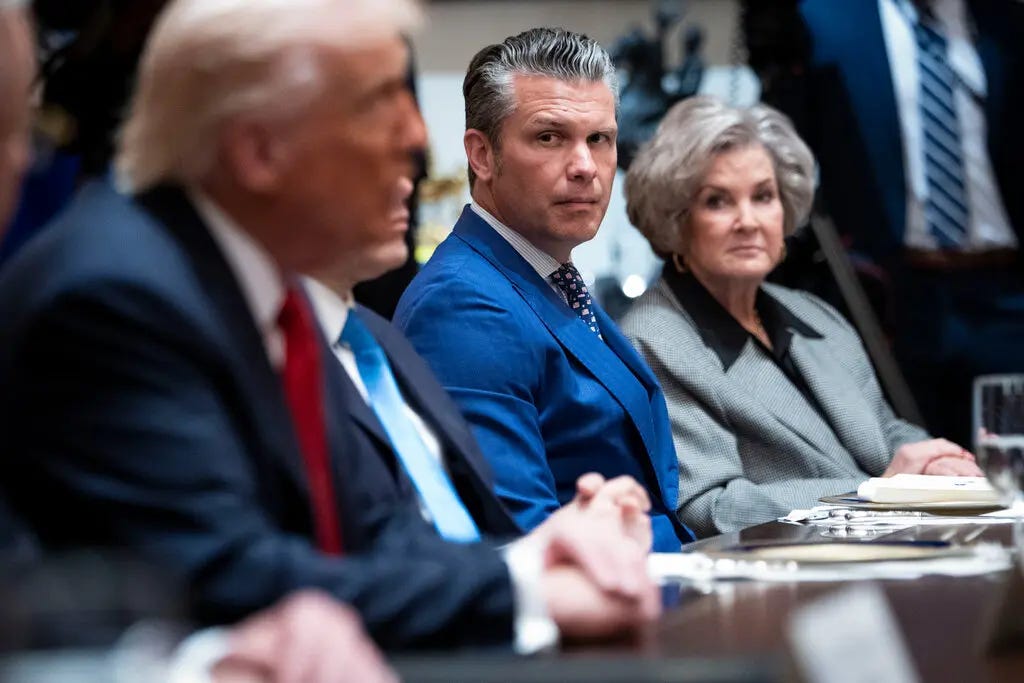
Photo: Doug Mills/The New York Times
Overview
Date: October 24, 2025
Summary: The Trump administration is significantly escalating its military campaign against drug trafficking in Latin America by deploying the USS Gerald R. Ford aircraft carrier strike group to the Caribbean. This move, announced by Defense Secretary Pete Hegseth, comes as the U.S. continues a series of lethal strikes on suspected drug boats, resulting in 43 deaths across 10 incidents since September. President Trump and Hegseth have equated drug cartels to terrorist organizations like Al Qaeda, justifying the strikes as an “armed conflict” and signaling potential future land-based operations, particularly in Venezuela. The escalation faces legal scrutiny and congressional opposition regarding its legality and lack of formal war authorization.
Sources
The New York Times - U.S. Deploys Aircraft Carrier to Latin America as Drug Operation Expands
CNN - Trump considering plans to target cocaine facilities inside Venezuela, officials say
NBC News - U.S. to send aircraft carrier strike group to Caribbean in an escalation of boat strikes
The Washington Post - Pentagon orders aircraft carrier to Latin America as Trump signals escalation
The Wall Street Journal - Pentagon Orders Aircraft Carrier to the Caribbean
Key Points
The U.S. is deploying the USS Gerald R. Ford aircraft carrier strike group, including accompanying warships and attack planes, to the Caribbean, marking a significant military escalation in Latin America.
Defense Secretary Pete Hegseth announced the deployment, stating its purpose is to bolster U.S. capacity to detect, monitor, and disrupt illicit actors, dismantle Transnational Criminal Organizations, and counter narco-terrorism in the Western Hemisphere.
This deployment is part of an ongoing U.S. campaign involving lethal strikes on suspected drug boats in international waters, primarily in the Caribbean and Eastern Pacific, which has resulted in 43 deaths across 10 known incidents since early September.
President Trump and Secretary Hegseth have repeatedly equated drug cartels and criminal gangs like Tren de Aragua and the National Liberation Army (ELN) to terrorist organizations such as Al Qaeda, asserting the U.S. is engaged in an “armed conflict” with them.
The administration justifies the lethal strikes by claiming drug trafficking constitutes an armed attack on the U.S. and that killing suspected traffickers saves American lives from overdose deaths.
The deployment of the carrier and other forces, which nearly doubles the U.S. military presence afloat in the region, is seen as a strong signal of potential future land-based operations, particularly within Venezuela, and aims to increase pressure on Venezuelan leader Nicolás Maduro.
The administration has faced criticism and questions from legal specialists and members of Congress regarding the legality of the strikes and the lack of formal congressional authorization for military force against these groups.
Unique Highlights
The New York Times details the legal arguments against the administration’s actions, citing outside legal specialists who state it is illegal to deliberately target civilians not directly participating in hostilities, even suspected criminals, and that drug trafficking penalties are prison, not execution. It also highlights the distinction between fentanyl (from Mexico, causing overdose deaths) and cocaine (from South America, allegedly transported by the attacked boats).
CNN specifically mentions that President Trump has authorized the CIA to conduct covert operations in Venezuela and that newly released video shows Venezuelan President Nicolás Maduro pleading for peace. It also notes the reopening of Naval Station Roosevelt Roads in Puerto Rico, which had been shuttered since 2004, as a hub for U.S. military operations.
NBC News provides specific details about the concerns raised by top Democrats on the Senate and House Intelligence committees, Sen. Mark Warner and Rep. Jim Himes, who sent a letter to Director of National Intelligence Tulsi Gabbard requesting information on the factual basis, effects, and legality analysis by intelligence community lawyers regarding the strikes.
The Washington Post highlights the deployment of the MV Ocean Trader, a civilian ship converted into a floating Special Operations base, and the 160th Special Operations Aviation Regiment, an elite helicopter unit. It also mentions visuals showing MH-6 Little Bird helicopters less than 90 miles from Venezuela’s coastline, configured for Special Operations ground assaults, though officials stated they were for flight training.
The Wall Street Journal provides a quote from Geoff Ramsey, a Venezuela analyst at the Atlantic Council, suggesting the administration is “giving up on the hope that Venezuela’s military leaders will rise up and overthrow Maduro themselves” and is now determined to “take things into its own hands,” while warning of a “Libya-style meltdown.” It also mentions the deployment of AC-130J Ghostriders and Tomahawk missile-armed destroyers as part of the carrier strike group.
El País uniquely reports on the U.S. imposing sanctions against Colombian President Gustavo Petro, his wife, son, and Interior Minister Armando Benedetti, placing them on the “Clinton list” for association with drug trafficking, following Trump’s rhetoric calling Petro a “thug” and Colombia a “drug shanty.” It also notes Trump’s announcement of suspending U.S. funding to Colombia.
Contrasting Details
Venezuelan Cocaine Production: While CNN and El País state that Venezuela is not known to be a major cocaine-producing country, citing the United Nations Office on Drugs and Crime (UNODC) and the U.S. Drug Enforcement Administration (DEA), the Trump administration, as reported by all sources, aggressively links Venezuelan President Nicolás Maduro to the drug trade and is considering targeting cocaine facilities and routes inside Venezuela.
Legality of Strikes: The New York Times and El País emphasize that outside legal specialists and senators from both parties view the strikes as potentially illegal or lacking proper authorization, arguing that deliberately targeting suspected criminals without due process is forbidden under domestic and international law and that the administration has not provided a sufficient legal theory. In contrast, all articles report President Trump and Defense Secretary Pete Hegseth assert the attacks are lawful, claiming an “armed conflict” with cartels and that congressional approval is not required.
Fentanyl vs. Cocaine: The New York Times and NBC News highlight that the rise in U.S. overdose deaths (often cited by Trump to justify strikes) is primarily due to fentanyl from Mexico, which is mostly smuggled over land borders. The boats being attacked, however, are coming from South America and primarily transport cocaine, suggesting a potential disconnect between the stated justification for saving lives from fentanyl and the actual target of the maritime strikes.
The Newsie Project uses AI to summarize, compare, and contrast the reporting of the major US and world online news sources.
This is an evolving project. Tools, approaches, and output formats will change over time. The Newsie Project does not attempt to provide a definitive capsule of any news story. While the incidence of errors in these summaries is low, and I attempt to spot-check details, AI tools can hallucinate. Please click through and read the articles for details (some may be paywalled).