

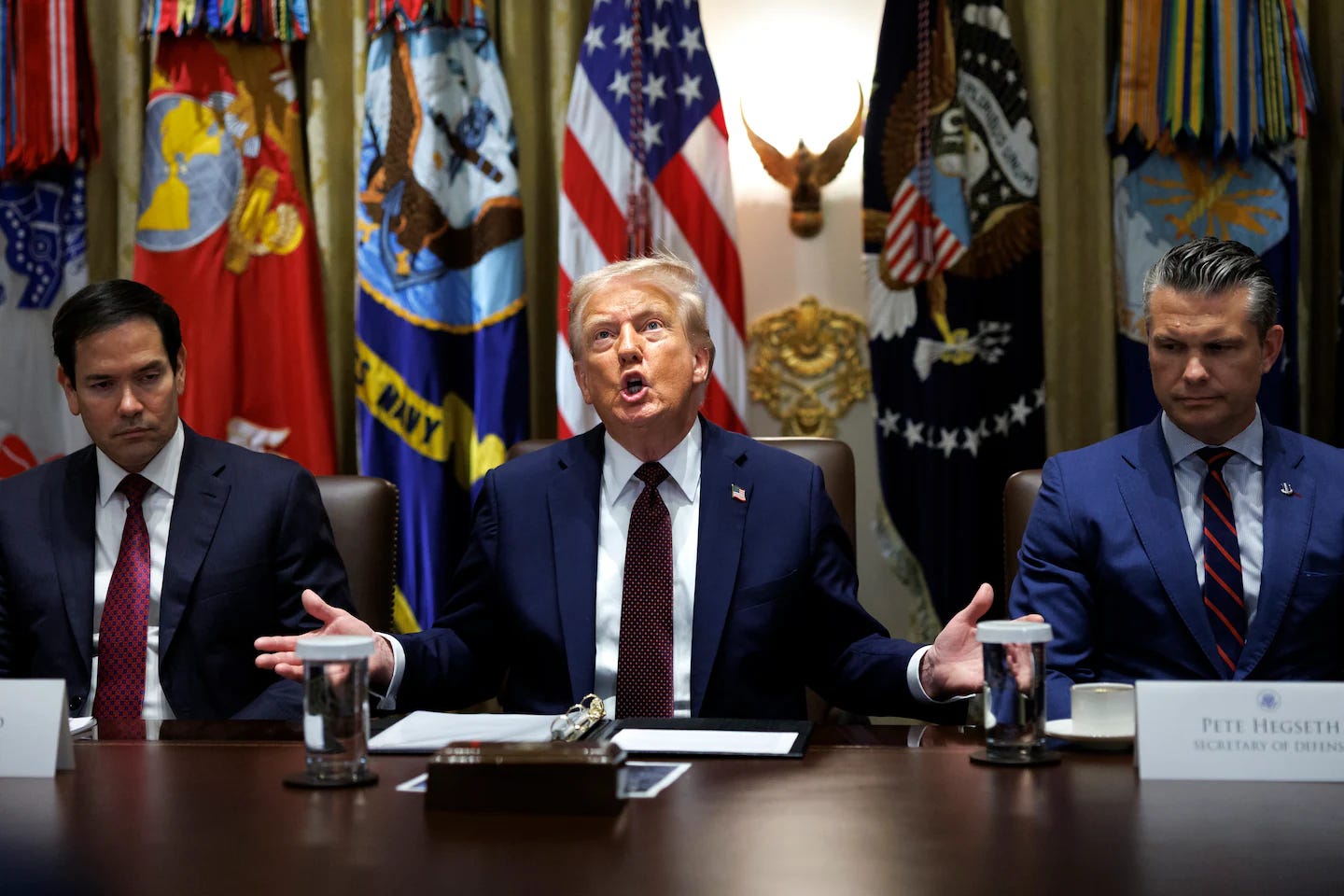
Photo: Tom Brenner/For the Washington Post
Overview
Date: August 29, 2025
Summary: The Trump administration has notified Congress of its intent to cancel $4.9 billion in congressionally approved foreign aid using a “pocket rescission.” This rarely used budgetary tactic involves making a rescission request so late in the fiscal year (which ends September 30) that Congress does not have the 45 days required to act, effectively canceling the funds unilaterally. This move has drawn widespread condemnation from both Democratic and some Republican lawmakers, as well as the Government Accountability Office (GAO), all of whom deem it illegal and an infringement on Congress’s constitutional “power of the purse.” The action also threatens to complicate ongoing bipartisan negotiations to prevent a government shutdown.
Sources
The New York Times - Defying Congress, Trump Moves to Cut $4.9 Billion in Foreign Aid
CNN - Trump bypasses Congress to cancel nearly $5 billion in foreign aid
NBC News - White House plans to use ‘pocket rescissions’ to slash billions in foreign aid
Fox News - White House move to cancel $4.9B foreign aid with ‘pocket rescission’ blasted as illegal
The Washington Post - Trump tries to wrest spending power from Congress as government shutdown looms
The Wall Street Journal - Trump Moves to Cut $4.9 Billion in Foreign Aid Without Congress’s Approval
Key Points
The Trump administration intends to cut approximately $4.9 billion in congressionally approved foreign aid.
The method employed is a “pocket rescission,” where the White House makes a rescission request within 45 days of the fiscal year’s end (September 30), preventing Congress from acting within the statutory period and thus unilaterally canceling the funds.
This tactic is widely criticized by both Democratic and some Republican lawmakers, including Senator Susan Collins (R-Maine), Chairwoman of the Appropriations Committee, as illegal, unconstitutional, and a violation of Congress’s “power of the purse.”
The Government Accountability Office (GAO), a nonpartisan oversight body, also considers pocket rescissions illegal.
The administration’s move is expected to complicate bipartisan negotiations to prevent a government shutdown, as federal funding expires on September 30 and Democrats have warned against unilateral funding cuts.
The White House, particularly OMB Director Russell Vought, asserts that pocket rescissions are a lawful tool and that the executive branch has broad discretion, arguing they are on “firm legal ground” and are a necessary step to reduce “unnecessary spending” or “America Last” programs.
The targeted funds primarily include the U.S. Agency for International Development (USAID), international peacekeeping operations, and the State Department’s Democracy Fund.
The tactic is historically rare, with the last comparable instance cited as nearly 50 years ago under Presidents Gerald R. Ford or Jimmy Carter.
Unique Highlights
The New York Times details the 15-page notification sent to Congress and notes OMB Director Russell T. Vought has openly “courted a legal showdown” over the issue, citing his past writings. It also elaborates on President Gerald R. Ford’s 1975 actions, where $10 million in targeted funds expired without a congressional vote, which the GAO at the time called a “major deficiency” in existing rules.
CNN quotes Secretary of State Marco Rubio describing the targeted aid as “woke and weaponized foreign aid money that violates the President’s America First priorities.” It provides specific cut amounts including $3.2 billion from USAID development assistance, $393 million from State Department peacekeeping, $322 million from the State Department’s Democracy Fund, and over $444 million in other peacekeeping aid.
NBC News specifically cites a “WatchBlog” post from the Government Accountability Office explaining why pocket rescissions are illegal, emphasizing that “Congress holds the power of the purse” and the Impoundment Control Act does not grant such authority to the president. It also highlights an earlier attempt by Trump and Elon Musk to gut USAID as part of the Department of Government Efficiency’s efforts.
Fox News reports a White House official stating the goal of the pocket rescission was to remove the “last remaining vestiges” of USAID, and that the administration was confident in winning court challenges, claiming, “We’ve been winning these cases in the court system as recently as the last two weeks.” It also notes that Senate Minority Leader Chuck Schumer and House Minority Leader Hakeem Jeffries sent a letter to Republican leadership prior to the announcement, inquiring if more rescissions were coming.
The Washington Post indicates that a federal judge in February had ruled Trump could not freeze international development funding, though that ruling was later scaled back by the Supreme Court. It further notes that a federal appeals court earlier this month held the administration could block funds to USAID, but primarily because the suing group lacked legal standing, implying it wasn’t a ruling on the merits of the pocket rescission’s legality. The article also reveals that records released last week showed the administration was blocking other funds (low-income housing, education, medical research) until agencies complied with executive orders, such as a new ban on diversity programs.
The Wall Street Journal quotes Rep. Steve Womack (R-Ark.) saying the latest move was “stretching the spirit” of the Impoundment Control Act and that he planned to raise the issue with House Speaker Mike Johnson and House Appropriations Committee Chairman Tom Cole. It also specifies that the new package targets over half a billion dollars for the United Nations and U.N.-affiliated organizations “that do not support U.S. policies or priorities or have been operating contrary to American interests,” including the U.N. peacekeeping mission in Somalia and development assistance in sub-Saharan Africa.
Contrasting Details
Government Accountability Office’s (GAO) Historical Stance on Pocket Rescissions:
The New York Times, CNN, and NBC News consistently state that the GAO has ruled or views pocket rescissions as illegal.
The Wall Street Journal provides a more detailed historical context, reporting that the GAO in 1975 had said such a move was possible and recommended closing a loophole. However, in 2018, the GAO reversed this, stating that Congress and court decisions combined had closed the loophole, effectively making the tactic illegal, which contrasts with a simple, consistent ruling of illegality.
Nature of Past Presidential Pocket Rescissions:
While CNN and The Washington Post state President Jimmy Carter used the last pocket rescission in 1977, The New York Times elaborates on President Gerald R. Ford’s 1975 actions where targeted funds “expired anyway” because Congress didn’t vote on them. This detail from The New York Times suggests Ford’s instance was more an exposure of a “major deficiency” in the law rather than a clear-cut, successful exercise of the specific “pocket rescission” authority the Trump administration claims.
White House’s Claim of Legal Victories:
A White House official quoted by Fox News asserts confidence in legal challenges, stating, “We’ve been winning these cases in the court system as recently as the last two weeks.”
In contrast, The Washington Post provides context on recent court rulings, noting that while an appeals court did allow the administration to block USAID funds, it was largely because the suing group lacked legal standing, not due to a ruling on the core legality of the pocket rescission itself. This nuance suggests the “wins” might be on procedural grounds rather than a substantive validation of the president’s impoundment authority, potentially presenting a differing interpretation of the legal landscape.
The Newsie Project uses AI to summarize, compare, and contrast the reporting of the major US and world online news sources.
This is an evolving project. Tools, approaches, and output formats will change over time. The Newsie Project does not attempt to provide a definitive capsule of any news story. While the incidence of errors in these summaries is low, and I attempt to spot-check details, AI tools can hallucinate. Please click through and read the articles for details (some may be paywalled).