

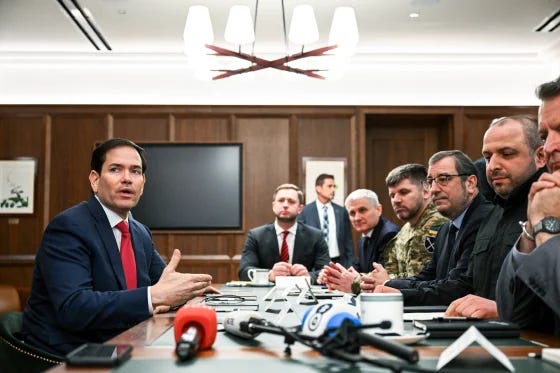
Photo: Chandan Khanna / AFP
Overview
Date: November 30, 2025
Summary: Top U.S. and Ukrainian officials met in Florida to discuss a peace plan to end the war with Russia, describing the talks as “productive” and “successful” despite a lack of specific details released. The Ukrainian delegation was led by Rustem Umerov following the resignation of Andriy Yermak amid a corruption investigation. Secretary of State Marco Rubio emphasized the goal of ending the war and ensuring Ukraine’s long-term safety and prosperity. Special Envoy Steve Witkoff is scheduled to travel to Moscow to continue discussions with Russian President Vladimir Putin. President Donald Trump expressed optimism about a potential deal but also highlighted concerns about corruption in Ukraine.
Sources
The New York Times - Rubio Says ‘Much Work’ to Be Done After Talks With Ukrainian Officials
NBC News - U.S. and Ukrainian officials hold ‘very productive’ meeting in Florida
CNN - November 30, 2025 — Trump administration news, Ukraine war talks, Venezuela tensions
Key Points
U.S. Secretary of State Marco Rubio, Special Envoy Steve Witkoff, and Jared Kushner met with a Ukrainian delegation led by Rustem Umerov in Florida to discuss a peace framework for the war with Russia.
Both U.S. and Ukrainian officials described the talks as “productive” and “successful,” acknowledging that “much work remains” and the negotiations are “delicate” and “complicated.”
The stated goals of the discussions include ending the war and establishing terms for Ukraine’s long-term safety and prosperity, ensuring it never faces another invasion.
Andriy Yermak, Ukraine’s chief of staff and former lead negotiator, resigned due to a corruption investigation shortly before the Florida talks, leading Rustem Umerov to step in. This corruption issue was noted by President Donald Trump as “not helpful.”
Special Envoy Steve Witkoff is scheduled to travel to Moscow to meet with Russian President Vladimir Putin for further discussions following the Florida meeting.
Russia’s role is considered central to any peace deal, and U.S. officials have been in contact with the Russian side to understand their views.
Ukraine has consistently sought future security guarantees, while Russia has demanded territorial concessions and a prohibition on Ukraine joining NATO.
Unique Highlights
The New York Times reports that Andriy Yermak had negotiated to soften a draft proposal from the Trump administration last week, which largely reflected Russian demands such as withdrawing from eastern Ukraine, forgoing NATO membership, and ruling out a postwar Western peacekeeping force for Ukraine. It also mentions that the proposal included a promise of security guarantees without detailing the level of commitment.
NBC News mentions that President Donald Trump previously tried to pressure Ukrainian President Volodymyr Zelenskyy to accept a proposal that would have given Russia more Ukrainian land beyond what it currently controlled. It also states that Trump said Army Secretary Dan Driscoll would meet with Ukrainians while Witkoff met with Putin.
The Wall Street Journal details that the talks covered possible timetables for new elections in Ukraine and the prospect of land swaps between Russia and Ukraine. It provides background on the initial 28-point peace plan, stating that Kushner and Witkoff met Kirill Dmitriev (Putin’s negotiator) in October to hash it out at Witkoff’s Miami Beach home. The initial proposal alarmed Ukraine and its European allies for offering concessions favoring Russia, including caps on Ukraine’s military but not Russia’s, and a ban on NATO membership.
The article highlights that Rustem Umerov initially found this draft favored Russia over Ukraine. It also elaborates on the legal hurdles for territorial changes in Ukraine, requiring a nationwide referendum, and the political complexities of holding elections during wartime.
The Wall Street Journal also notes Russia bombarded Ukraine with a nearly 10-hour air assault a day before the U.S.-Ukrainian meeting.
Fox News features an ex-CIA station chief, Dan Hoffman, who expressed skepticism about Russia’s genuine interest in peace, suggesting Putin uses negotiations to gain leverage on the battlefield and influence sanctions or military aid. Hoffman warned that ceding territory would be “extremely dangerous” for Ukraine, citing Putin’s history of violating agreements like the Budapest memorandum, and described Ukraine as the “strongest army in Europe” and the “bulwark of Europe’s defense.”
CNN reported that a source with direct knowledge described the Florida talks as “tough but very constructive,” involving discussions of “the most sensitive issues” for resolving the war. Ukrainian First Deputy Foreign Minister Sergiy Kyslytsya shared an upbeat social media assessment of the meeting.
Contrasting Details
While all articles agree on the “productive” nature of the U.S.-Ukrainian talks, Fox News provides a contrasting perspective through former CIA station chief Dan Hoffman, who expresses skepticism about Russia’s true intentions for peace, suggesting President Vladimir Putin uses negotiations primarily to gain leverage and influence rather than to genuinely end the conflict. This differs from the generally optimistic tone conveyed by U.S. and Ukrainian officials regarding the talks themselves.
The New York Times states that the Trump administration’s initial 28-point proposal largely reflected Russian demands, including specific concessions like withdrawing from eastern Ukraine and forgoing NATO membership. The Wall Street Journal expands on this by detailing that the proposal included caps on Ukraine’s military (but not Russia’s) and a bar from NATO, and explicitly notes that Rustem Umerov initially found this deal favored Russia over Ukraine. While not a direct contradiction, The Wall Street Journal provides significantly more detail on the specific “Russia-friendly” nature of the initial draft compared to The New York Times’ more general description.
The Newsie Project uses AI to summarize, compare, and contrast the reporting of the major US and world online news sources.
This is an evolving project. Tools, approaches, and output formats will change over time. The Newsie Project does not attempt to provide a definitive capsule of any news story. While the incidence of errors in these summaries is low, and I attempt to spot-check details, AI tools can hallucinate. Please click through and read the articles for details (some may be paywalled).