

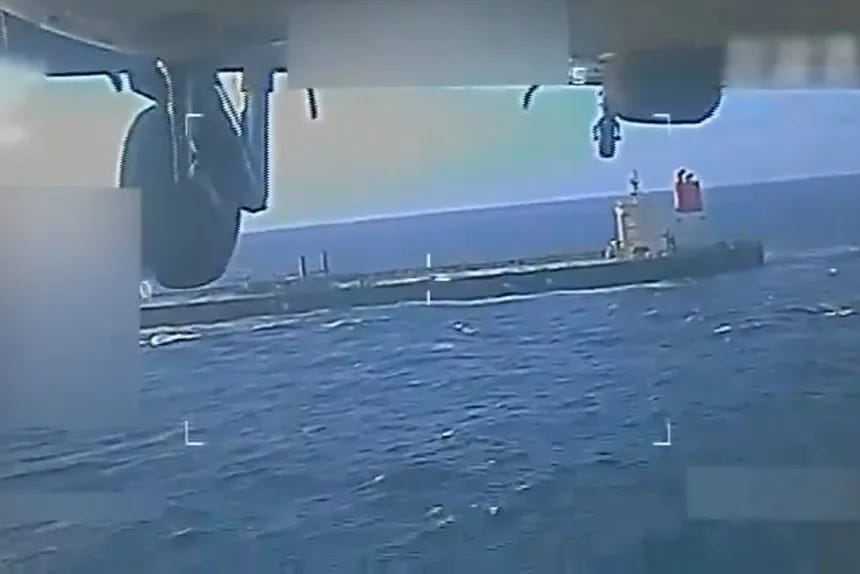
Photo: US Government (Pam Bondi/X)
Overview
Date: December 10, 2025
Summary: The United States seized a large oil tanker off the coast of Venezuela, an action confirmed by President Donald Trump as a significant escalation in his administration’s pressure campaign against Venezuelan leader Nicolás Maduro. Attorney General Pam Bondi stated the seizure was executed with a warrant against a vessel involved in an illicit shipping network transporting sanctioned oil from Venezuela and Iran, supporting foreign terrorist organizations. The operation, involving the FBI, Homeland Security Investigations, Coast Guard, and Pentagon, occurred amidst a broader U.S. military buildup in the Caribbean, targeting alleged drug smuggling and aiming to weaken Maduro’s government. Venezuela condemned the seizure as an act of piracy.
Sources
The New York Times - U.S. Seizes Oil Tanker Off Venezuelan Coast, Escalating Pressure on Maduro
NBC News - U.S. seizes oil tanker off the coast of Venezuela, Trump says
The Washington Post - U.S. seizes ‘very large’ oil tanker off Venezuelan coast, Trump says
Key Points
The United States seized a large oil tanker off the coast of Venezuela, confirmed by President Donald Trump, who described it as “very large” and potentially the “largest one ever seized.”
Attorney General Pam Bondi announced the operation involved the FBI, Homeland Security Investigations, and the U.S. Coast Guard, supported by the Pentagon or Department of Defense. She stated the tanker was used to transport sanctioned oil from Venezuela and Iran through an illicit shipping network supporting foreign terrorist organizations.
The seized vessel was identified as the “Skipper” and was carrying Venezuelan crude oil from Petróleos de Venezuela (PDVSA). It had previous links to Iranian oil smuggling, which was the basis for a federal judge issuing a seizure warrant.
The seizure is part of an escalating U.S. pressure campaign against Nicolás Maduro, aimed at undermining his government and potentially achieving regime change. Trump has accused Maduro of leading a “narcoterrorist” cartel.
The U.S. has significantly increased its military presence in the Caribbean, deploying thousands of troops, warships, and aircraft, and has conducted numerous strikes against alleged drug boats in the region, resulting in dozens of casualties.
Venezuela’s government condemned the seizure as a “barefaced robbery and an act of international piracy,” highlighting the country’s economic dependence on oil exports.
The timing of the seizure coincided with Venezuelan opposition leader María Corina Machado being formally bestowed the Nobel Peace Prize.
Both China and Cuba are significant recipients of Venezuelan oil, with the latter heavily reliant on these shipments for economic stability and to alleviate power outages.
Unique Highlights
The New York Times provided the specific number of known U.S. strikes against boats (22) and casualties (more than 80) since September. It also noted legal experts questioning if these strikes violate international law. It detailed Iran’s use of oil sales to finance its military and the Islamic Revolutionary Guards Corps. The article also mentioned Trump’s past phone calls with Maduro and his reservations about a regime change operation due to fear of failure, alongside his interest in extracting value from Venezuela’s oil for the U.S.
CNN reported that the seizure occurred in international waters and that the vessel, after heading to Cuba, was ultimately destined for Asia after being brokered through Cuban sellers. It also highlighted Cuba’s current severe power outages, which are exacerbated by limited fuel imports. It mentioned the Trump administration is working on “day-after plans” in the event Maduro is ousted.
NBC News noted that oil prices began steadily rising, climbing more than 1.3% or about 75 cents, as reports of the seizure circulated. It detailed Defense Secretary Pete Hegseth being scrutinized for a “double tap” strike that killed survivors of an initial attack and his defense of the action by citing the “fog of war.” The article also mentioned lawmakers from both parties initiating inquiries into the administration’s attacks on boats and Trump’s $50 million reward for Maduro’s arrest.
The Washington Post stated that the legal authority for the seizure was “not clear,” and a person familiar with the seizure suggested it could have a “big financial impact.” It cited Reuters reporting Venezuela’s daily export average of about 900,000 barrels, up from last year but far below 2.4 million barrels in 2008. The article also mentioned the 2020 U.S. seizure of 1.1 million barrels of Iranian fuel from four vessels headed to Venezuela, and that María Corina Machado dedicated her Nobel Peace Prize, in part, to Trump.
The Wall Street Journal reported that María Corina Machado left Venezuela on a boat just hours before the tanker seizure. A Pentagon official stated the move was a warning to other tankers waiting to dock off Venezuela, noting maritime tracking data showed about a dozen such vessels, some with their Automatic Identification System turned off. The article identified the Skipper as formerly the “Adisa,” sanctioned by OFAC for carrying Iranian crude, and detailed that it was covertly loaded with 1.1 million barrels of Merey crude in mid-November without its transponder. It also provided estimates of Maduro’s government revenue from licensed foreign oil activities ($1.8-$2.2 billion).
Fox News specified that the seizure was led by the Coast Guard and supported by the Navy. It stated that Trump revoked Chevron’s license to purchase oil from Caracas earlier in 2025 and mentioned the deployment of 10 F-35 jets to Puerto Rico and F/A-18s flying over waters north of Venezuela. The article also reported that Trump directed airlines to steer clear of the area, which analysts speculated could precede land strikes. It detailed Venezuela’s use of a “shadow network” of reflagged tankers, shell companies, and ship-to-ship transfers with transponders off or spoofing locations.
Contrasting Details
Chevron’s License Status: The Washington Post reported that Chevron’s license to resume operations in Venezuela was reissued in July, while Fox News stated that Trump revoked Chevron’s license to purchase oil from Caracas earlier in 2025.
Maduro’s Immediate Response: CNN noted that President Maduro did not address the seized tanker in a speech on Wednesday as news circulated. In contrast, NBC News quoted Maduro referring to tensions with the U.S. and stating, “It’s time for combat,” without explicitly mentioning the tanker, suggesting a general rather than specific response.
Legal Authority for Seizure: The New York Times stated that a federal judge issued a seizure warrant roughly two weeks prior due to the ship’s past activities smuggling Iranian oil, not its links to the Maduro government, and questioned whether the U.S. had the legal authority to keep the oil. The Washington Post stated that the “legal authority for the seizure was not clear.” The Wall Street Journal, however, cited Schreiner Parker, an analyst, who said the State Department’s designation of Venezuela’s Cartel de los Soles as a foreign terrorist organization provides a legal pathway for the U.S. to seize anything materially financing it.
The Newsie Project uses AI to summarize, compare, and contrast the reporting of the major US and world online news sources.
This is an evolving project. Tools, approaches, and output formats will change over time. The Newsie Project does not attempt to provide a definitive capsule of any news story. While the incidence of errors in these summaries is low, and I attempt to spot-check details, AI tools can hallucinate. Please click through and read the articles for details (some may be paywalled).